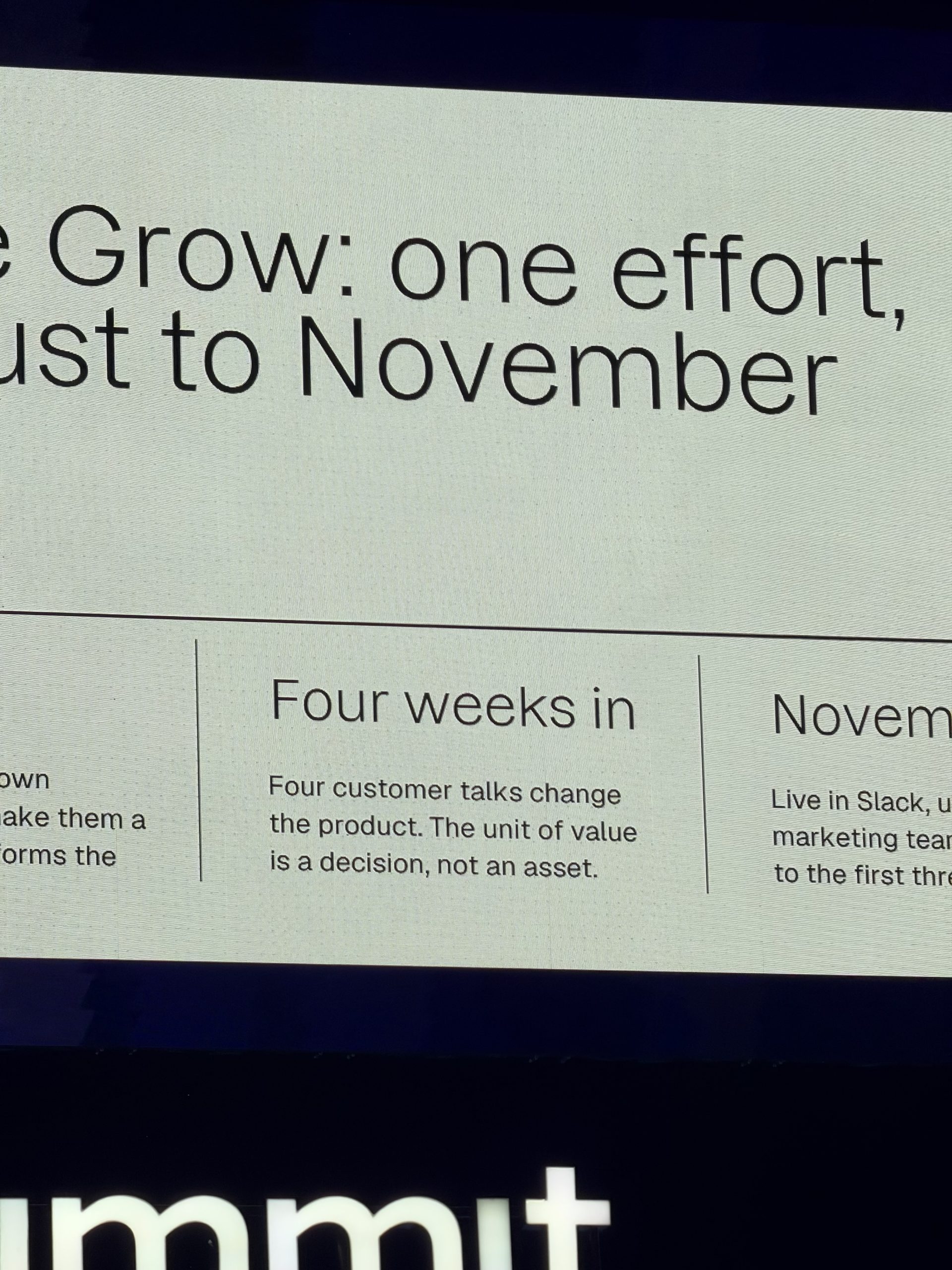
I went to Web Summit last week in Lisbon. Getting value from an event like this (70k people, infinite pitches, stages and “pavilions”) is difficult. You do, however, get lucky sometimes. I managed to get a seat for a talk from the CPO of Base44, Yoav Orlev, who shared how they were using their own product (product placement much?) to insource applications they didn’t want to pay for anymore. It was interesting to see where this was viable for them as a company and where the depth of existing apps and ecosystems were too difficult to replace with vibe coded solutions. The biggest takeaway for me was a tiny line in one of his slides, perhaps even a throwaway line. “The unit of value is a decision, not an asset.” This struck me as the core of his talk and what I want to dive into in this week’s post.
AI is increasing the appetite for data-informed decisions
While I was at Web Summit Amazon, Google and Perplexity all launched AI-powered decision services. It’s becoming increasingly clear that as the cost of producing artifacts declines, the cost of making decisions with those artifacts and other data is where companies are now focusing. The evidence for this is everywhere. Last week I wrote about Linear trying to deal with 1000 pull requests per day. In a recent talk, Christian Bird, formerly of Microsoft, shared how agent usage raised commits at his former employer 240% while releases only increased by 30%. Everything product teams used to get credit for producing, whether it’s a prototype, PRD, roadmap or production code, is now abundant. Continuing to measure your teams on those metrics no longer makes sense.
This is why Orlev’s quote hit home for me. The production of an asset is no longer uniquely valuable to an organization. It is the decision that the team is making using those assets and the insight they generate that is where the value truly lies. Let’s be clear on what a decision actually consists of because it’s more than just “let’s do X.”
A decision is a commitment to a path of action that consists of four parts:
- A name – who owns the decision and is responsible for ensuring its success. This needs to be an actual human.
- A hypothesis the decision is based on – my preference, no surprise, is for the Lean UX version of the hypothesis but ultimately it doesn’t matter as long as that hypothesis is clearly stated and attributed to the decision.
- A date for revisiting the status of the decision – exactly when the team will review how well (or not) the decision worked out
- A metric to make the kill/pivot/persevere decision – on the review date, how will we objectively decide what to do with the outcomes of the decision we made
How to count what your team decided this week (not what it built)
This seemingly simple idea has been at the heart of my work for the last 20 years. It seems so obvious and simple that every company should be working and thinking this way. But we come from an industrial manufacturing history and thinking in features is just how most people work. However, as AI changes literally everything, the assets we’re producing have less and less value while what we decide to do each day bears much more impact on the success of our products and services. Here’s how to keep clear, objective track of your decisions and their impact:
- Keep a decision log, not a change log. With each deployment, log exactly what was committed to, the evidence that led to that decision being made, the owner of the decision and the review date. These few extra data points will come in very handy when it’s time to review each commitment.
- Change the question you ask at the Monday standup. Instead of asking “What did we ship last week?” ask your teams to talk about what they decided last week and, equally as important, what they decided to stop as well. This is where we begin to deal with all of the features we’ve shipped and never retired that we should have.
- Reward evidence-based decision-making. Recognition for value added to the customer and to the company should be based on decisions that proved right and the ones that proved to be wrong quickly. If there is a reward for stopping something or not doing it in the first place, the team begins to focus on better decision-making immediately.
Companies are hiring decision-makers
In the late 2026 product management hiring report from Lenny it was reported that PM job openings are up 75% while design and research opportunities are at historic lows. While I hate to see that second statistic, what this says to me is that companies are hiring “deciders.” There’s an assumption that high-quality quantitative and qualitative data will be available for these folks (that’s a topic for another post) so we need more humans to exercise the thing AI can’t give us – judgment. Without these clear decision logs and criteria for objective decision making it will be far more difficult for these newly hired product managers to make these critical calls AI-driven product development requires in a timely manner.




Leave a Reply