This post was heavily inspired by a conversation that I saw on LinkedIn (that I can no longer locate) with Roger Martin where he discussed these ideas. I’d written down the topic as one to explore later and forgotten to give credit to Professor Martin when I published this post. For all things strategy, start with his work first.
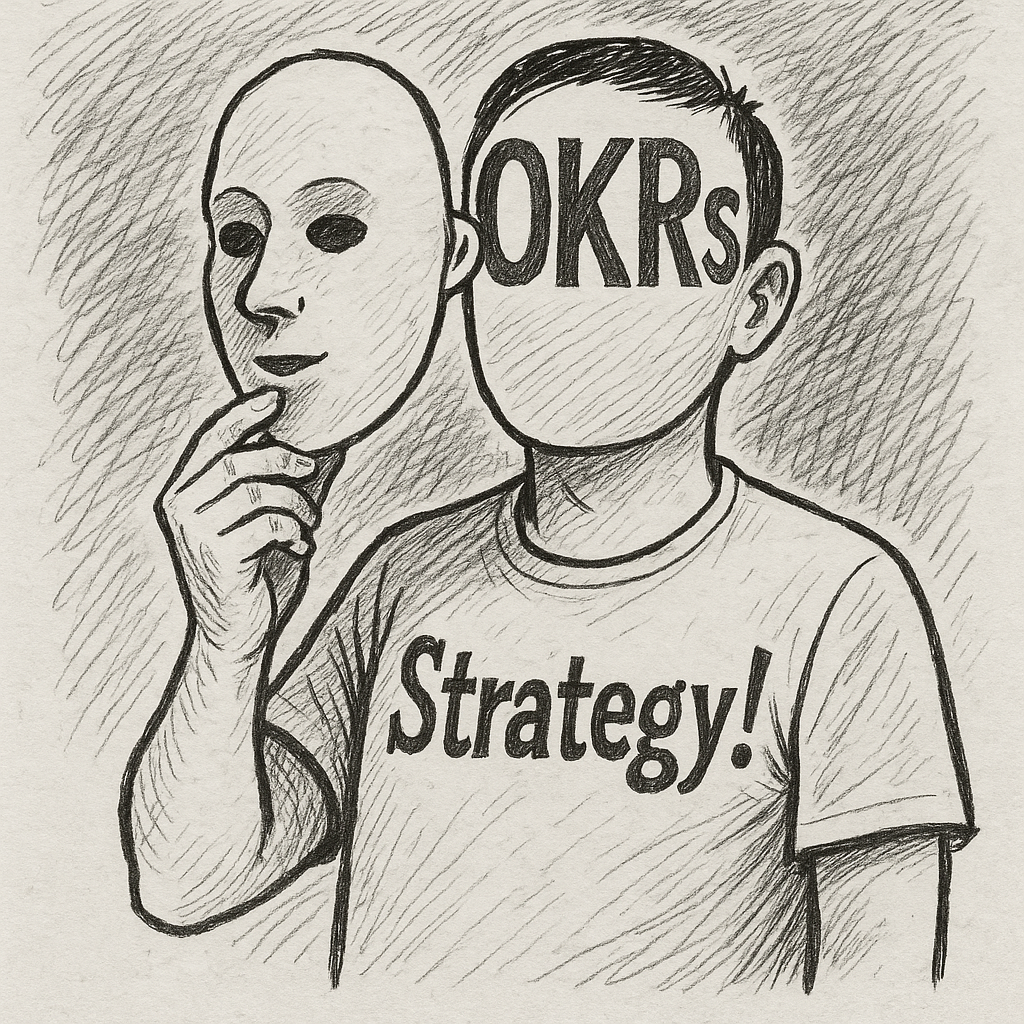
If you’ve found yourself debating your goals, specifically Objectives and Key Results, with your colleagues in an effort to sharpen or focus them but couldn’t get alignment, you’re likely lacking strategic direction. “But OKRs are our strategy!”, someone undoubtedly said. No, they’re not. In fact, without an established, understood and agreed upon strategy your OKR efforts will move forward but will struggle for cohesion. Here are three clues your OKRs are masquerading as strategy.
The OKRs are the closest thing to strategy you have
The first and most obvious clue that your OKRs are masquerading as strategy is the lack of an actual strategy. Every time someone looks for a strategic direction another person tells them that the OKRs are in fact the strategy. Let me be as clear as I can here: OKRs are not strategy. I’m tempted to type it again but I won’t.
Objectives and Key Results are the goals that we use to tell us if we are headed in the same (and desired) strategic direction. They are barometers of progress towards goals that should be anchored in a strategic direction. They are not, on their own, that strategic direction.
Here’s an example. Imagine you work for a shipping company that employs many truck drivers and delivery people. As the use of autonomous vehicles grows across your value chain you need to respond to this radical change or get left behind. Your goals could be to increase the number of packages delivered by each human. Your goals could be to reduce the time it takes to deliver each package. Your goals might also include increasing automation in your delivery services. Which goal should the teams work on? Each of these can make an excellent OKR but the only ones that actually matter are the ones that align with your strategy.
If your strategy is to get with the times and automate you’ll set goals that reflect that direction. If your strategy is to optimize the productivity of your existing workforce, you’ll set different goals. You see where this is headed. Without strategy you could write excellent OKRs that take you exactly nowhere good.
OKRs don’t make sense across the organization
Imagine the shipping organization mentioned above again. Now imagine that each department set OKRs that drive towards each of the strategies proposed above. Then, you, the business leader, start to look across the organization only to see goal after goal pulling the company in opposing directions. Some teams are working towards automation while others work towards driver and delivery optimization. As they attempt to collaborate they realize they’ve nothing to learn from each other and, in fact, are actually competing against each other. This is another sign your organization lacks strategy and is leaning too heavily on OKRs.
Global decision-making is struggling
At the local level your teams are moving quickly, making decisions that align with their goals and trying to make progress. At the global level however you and your team are struggling. Every decision you make to enable one part of the organization clashes with the priorities of another part. Funding one initiative hamstrings the progress of another one. As you try to make critical prioritization and funding decisions, there is no guiding light. Each business unit is focused on its own needs and isn’t aligned with the others. Once again, your OKRs feel like they’re driving progress (and perhaps they are at the team level) but across the organization as a whole no decision can be made for “the whole.”
A solid strategic foundation ensures OKR success
Let me say it again here. OKRs are not strategy. They are a reflection of the progress you are making towards achieving your strategy. Do not rely on them for strategic direction but rather as a barometer for progress. If you see any of the above symptoms challenge the organization and your leaders to define a strategic direction. You’ll all benefit from it — as will your customers.