You can’t read the news today without reading about yet another company laying people off because of “AI.”
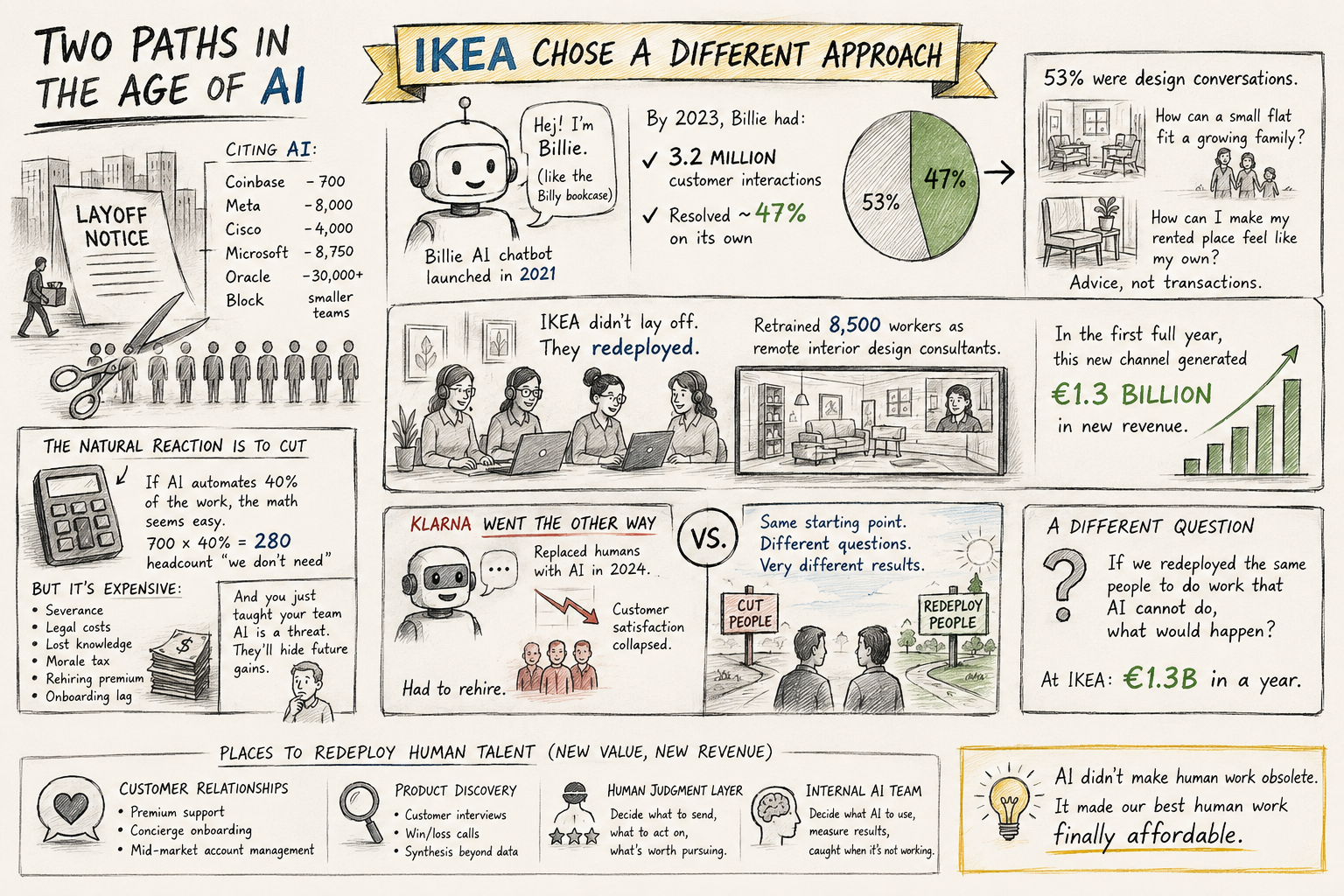
Coinbase cut 14% of the company, about 700 people. Citing AI. Meta laid off 8,000 folks, 10% of the workforce on May 20. Cisco just fired 4,000 people also citing AI as the main reason.
If you keep scrolling you’ll find Block telegraphing “smaller, faster teams using AI.” Microsoft offering 8,750 employees voluntary retirement. Oracle eliminating up to 30,000 positions. The first quarter of 2026 closed with about 80,000 tech workers laid off nearly half of them officially attributed to AI. Every one of these announcements points to the same story. AI lets us do the same work with fewer people, therefore, cut the people.
IKEA chose a different approach
In 2021, IKEA’s parent company Ingka Group rolled out an AI chatbot called Billie, named after the Billy bookcase. By 2023, Billie had handled 3.2 million customer interactions and resolved roughly 47% of them on its own. Billie had automated a meaningful chunk of customer service. You’d think IKEA would then make the obvious move and decimate the customer service staff.
They didn’t.
Instead, the company took a discovery style approach and looked at the 53% Billie couldn’t handle and asked a different question. What is actually in those conversations? Surprisingly, the conversations the bot couldn’t close were rarely about defective screws or delivery dates. They were design conversations. Customers were trying to figure out how a small flat could fit a growing family and what IKEA products would help them achieve their goals. Renters were trying to make their rented place feel like their own. IKEA’s customers – the 53% the bot couldn’t handle on its own – were asking for advice, not transactions.
Rather than laying off their call-center staff, IKEA retrained 8,500 workers as remote interior design consultants. These were the same people, trained to do new, creative human work the AI couldn’t handle. In fact, these design conversations required the warmth and understanding only humans could provide. In the first full year of the program, this new channel generated €1.3 billion in new revenue. Ingka is now targeting 10% of total group revenue from remote design consultation by 2028.
Payments company Klarna went the other way. They replaced humans with AI customer service in 2024, then quietly reversed course when customer satisfaction collapsed and they had to rehire. Both companies started from the same current condition, read the data and interpreted it differently. Klarna didn’t check into the nature of the conversations themselves. The end results could not have been more different.
What AI actually does to your org chart
I’ve been writing about this all year. AI is a new tool and a new material. It’s something teams can build with and build on top of. And, almost as a byproduct, AI is a diagnostic. The fastest one we’ve ever had.
As your company’s AI tool of choice integrates into your existing workflows, it begins doing a significant percentage of the work your team was doing within weeks. That percentage is a number you’ve never had visibility into before. It’s the share of the work that is repetitive and doesn’t require human judgment. It’s the boilerplate response or the follow-up email that always says the same thing. That inefficiency was always there. AI made it obvious. It’s no wonder then that the natural reaction is to take what seems like the obvious next step and cut out that inefficiency in the name of profit and productivity. And yet, IKEA is showing us that we are repeatedly getting that part wrong.
The natural reaction is to cut
The numbers seem obvious. If AI is automating 40% of the work, the math is easy. Take your 700 employees (or whatever) and multiply by 40% and voila, you have 280 headcount you “don’t need” any more. I understand the logic on the surface. It begins to fall apart though as you dig a bit deeper.
Layoffs are expensive. When you add up the costs of severance, legal, lost institutional knowledge, the morale tax on the people who stay (and start updating their LinkedIn profiles), the hiring spree that begins six months later when the company realizes it cut the wrong functions, the rehiring premium, the onboarding lag etc you end up with a bill that begins to rival the supposed inefficiencies AI revealed only a month earlier. Companies that ran this analysis post-pandemic learned it the hard way. The people you cut in Q1 are the people you’re paying recruiters double for in Q3.
Then there’s the second-order cost which is far more difficult to detect. You just taught your remaining team that AI is a threat to their jobs. From that day forward, every productivity gain any of them creates is one they have a personal incentive to hide. This part of the layoff math doesn’t usually make the press release.
A different question
The unique thing IKEA’s leadership asked is this:
If we redeployed the same people to do work that AI cannot do, what would happen?
The answer at IKEA was €1.3 billion in a year.
Not every company is guaranteed this result. But the question stands on its own across every company and almost none of the companies cutting right now are bothering to ask it. Coinbase frames its layoff as “becoming an AI-native firm.” Block’s CEO talks about “moving faster with smaller teams.” I actually don’t disagree with either of these statements. However, the language they’re using assumes there’s one path through AI, and that path is fewer people.
There’s at least one other path. It’s the path where you take the people whose monotony (and likely the parts of their job they hated the most) just got automated and you put them somewhere that needs human judgment, human creativity, or human reassurance. Those somewheres exist in every organization I’ve ever worked with. They’re just not necessarily on the org chart yet.
A few places to start looking:
- Customer relationships that used to be too expensive to scale.
- Premium support.
- Concierge onboarding.
- Account management for the middle of your customer base (the segment that’s currently underserved because it didn’t justify human contact before.)
AI handles the cheap part of the conversation. Humans handle the part where the customer is making a real decision. Oh, and by the way, these are potentially new revenue streams that were simply “too expensive” before.
When it comes to product management, there is tremendous potential as well. For example:
- The discovery work nobody has time to do.
- Customer interviews.
- Win/loss calls.
- Synthesis of what’s actually happening with the product beyond data analysis.
Most teams I work with have a backlog of discovery work that’s been waiting two years for someone to do it.
The people we have on our teams right now are the judgment layer above AI output. Someone has to decide which AI-generated draft to send and how to edit it, which prediction to act on, which experiment is worth running. That’s not a managerial role. It’s an IC-level craft role. Most companies are trying to fill it with people who don’t have time. The right person is the one who used to do the underlying work. They’re the only ones who can spot when the model is wrong.
Another opportunity for redeployment is the internal product team for AI itself. Every company is becoming an AI consumer at scale but almost none have successfully and sustainably built the internal function that decides what AI to deploy where, measures whether it’s working, and catches when it isn’t. That function is going to exist in every company within three years. You might as well staff it with people who already know your business.
The throughline here is that these are all human-creativity-and-judgment roles. AI didn’t make them obsolete. AI made them affordable. It also makes them obvious if you make the effort to look at the data. 47% of calls handled autonomously is only one part of the story. What’s happening in the other 53%? That’s the magic question. And, guess what, it’s a product management question too.
Using customer discovery to redesign your org for the AI era
If you’re being asked to stack rank your folks for the next round of AI-fueled layoffs, try taking a page directly from your product management playbook. Pick five people whose roles are now 50%+ automated and put them in a room with the senior leader of a different function — sales, product, customer success, finance, doesn’t matter — and ask, what is on your wish list that we’ve never had a budget for before?
Then listen.
You’ll get more answers than you expect. Most of them won’t fit your current job descriptions. That’s fine. Most of the job descriptions are wrong now anyway. Propose a hypothesis for redeploying these people to do the work we never had time to do before. Set clear behavior-based success metrics. See how taking the deep internal knowledge of existing staff and applying it to other parts of the business impacts the product and the customer experience.
IKEA made €1.3 billion betting on that while the rest of the industry is making severance payments.




One response to “AI made the boring work visible. Cut the work, not the people.”
This framing is refreshing — too many teams reach for headcount cuts the moment AI exposes the busywork. The real win is letting people redirect that freed-up time toward higher-judgment work. We saw this firsthand: once an AI image generator absorbed the repetitive production tasks, the team finally had room for the creative direction that actually moves the needle. The tool didn’t replace anyone — it made the boring work visible, exactly as you describe.