I once thought Lean UX had reached everyone who needed it. By 2016 or 2017, a few years after the book came out, it felt like every designer, PM, and engineer who cared about collaboration had already read it or taken the class.
Then Jared Spool invited me to teach a workshop at one of his events. “Do you think there’s anyone left who hasn’t taken my class at this point?” I asked him. He laughed. “You’ve barely scratched the surface.”
He was right. Today, Lean UX is in its third edition, and while we now often use the more inclusive term product discovery instead, the need for a collaborative way to find, test, and validate new opportunities has never been greater.
And nowhere is that need clearer than in the age of AI.
AI doesn’t replace discovery — it multiplies the need for it
Much like the height of the Agile boom, every company today is “adding AI” to its products and services — or at least saying they are. Meanwhile, a flood of startups, new and old, are chasing “AI-enabled” everything, backed by funding levels we haven’t seen since the late 1990s.
But the uncomfortable questions remain:
- What problems are these products actually solving?
- Who are they for?
- And how do we measure success when both the input and output are non-deterministic?
Most teams don’t stop to ask. Questions slow them down. Shipping feels faster.
But if we don’t ask, we can’t know whether we’re delivering any value at all.
AI can make products more powerful or more confusing. It can delight users or completely miss their intent. Did you choose the right use case? Did you implement it well? Does it make your users more productive — consistently?
That’s what product discovery is for. It helps your teams answer those questions before you’ve burned through a mountain of money on “AI-enabled” features that don’t matter.
“Shipped and works as designed” has never been a measure of value. It’s a measure of velocity.
Let’s leave that phrase in the past.
AI supercharges discovery — if you use it right
AI can make it feel like we can skip discovery. Why sketch when Lovable, Bolt, or V0 can generate a clickable prototype in minutes? Why interview customers when ChatGPT can role-play any persona you can imagine?
Those aren’t bad uses. In fact, they’re exciting. They help us get to the right questions faster.
AI-powered tools for product design and development are making discovery better by accelerating learning. We can now test more ideas with more users, faster. Anything that improves our time-to-learning is a win.
Interview guides, prototypes, research plans, qualitative synthesis, rough sketches, even synthetic personas — all of these can now be AI-assisted. Used well, they help us reach real human insight sooner and more reliably.
AI isn’t making discovery obsolete — it’s making it impossible to skip.
Discovery gets trickier when the answers aren’t predictable
Still, the process has to evolve. AI-driven systems behave differently from traditional software.
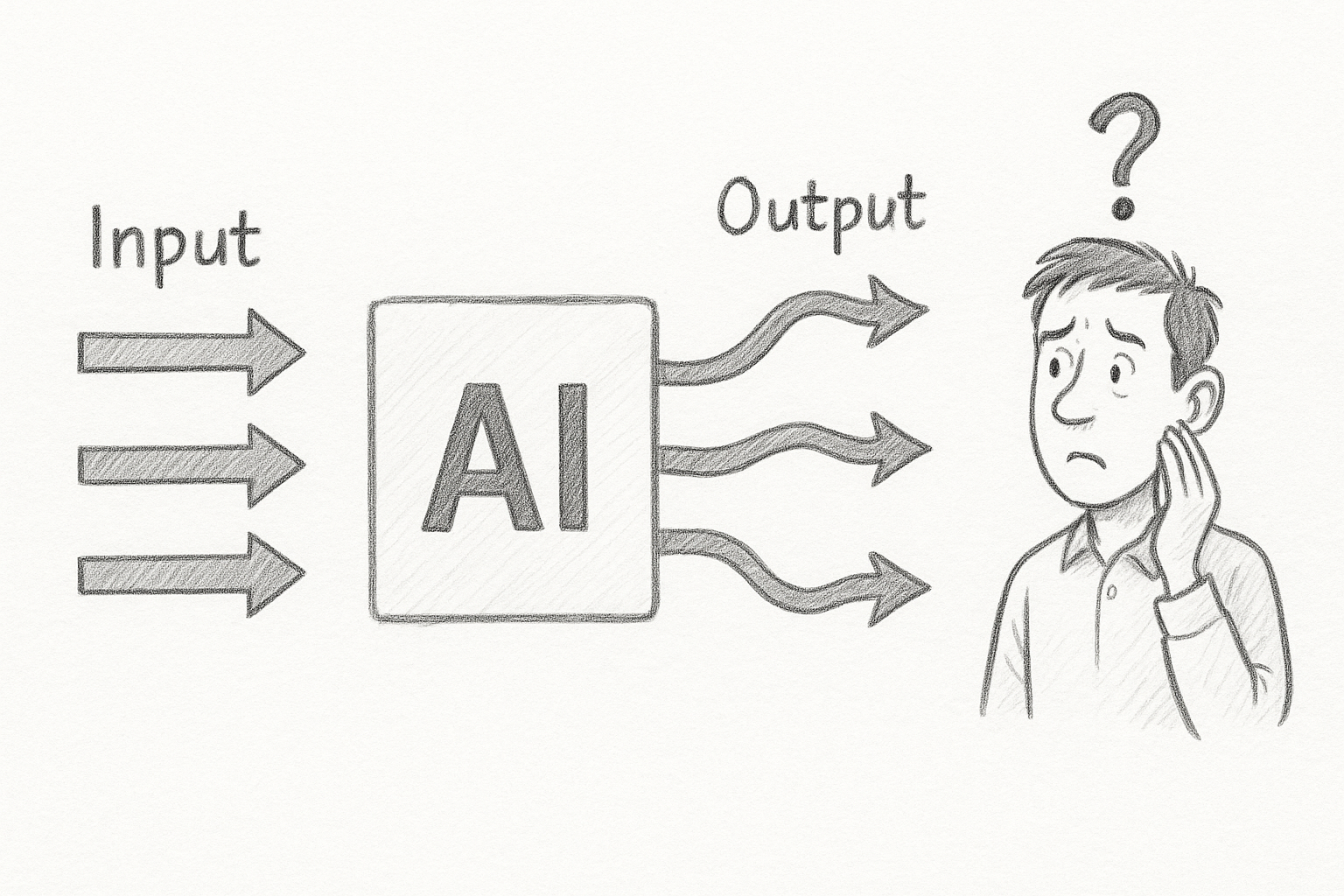
They take non-deterministic input and produce non-deterministic output — meaning we can’t always predict what people will type or what the system will return.
That unpredictability is the whole point of AI. It helps users explore new, unpredictable paths. But it also means we need new ways to:
- shape how our bots behave,
- evaluate their responses, and
- tune the models, prompts, and architectures behind them.
Product discovery has to adapt to that. It’s how we teach the machines to be useful.
Product discovery’s biggest obstacle hasn’t changed
The challenge, as ever, is getting the evidence we collect — now faster than ever — into the product development process. If we fail at that, all this new AI horsepower just builds more stuff no one needs.
Product discovery never lacked relevance or product-market fit. The need for it has always been there. What we need now is the discipline to keep it front and center, especially when shiny new technology tempts us to move faster than we can learn.
So if your team is adding AI, ask yourself:
How will you know it’s actually helping your customers?