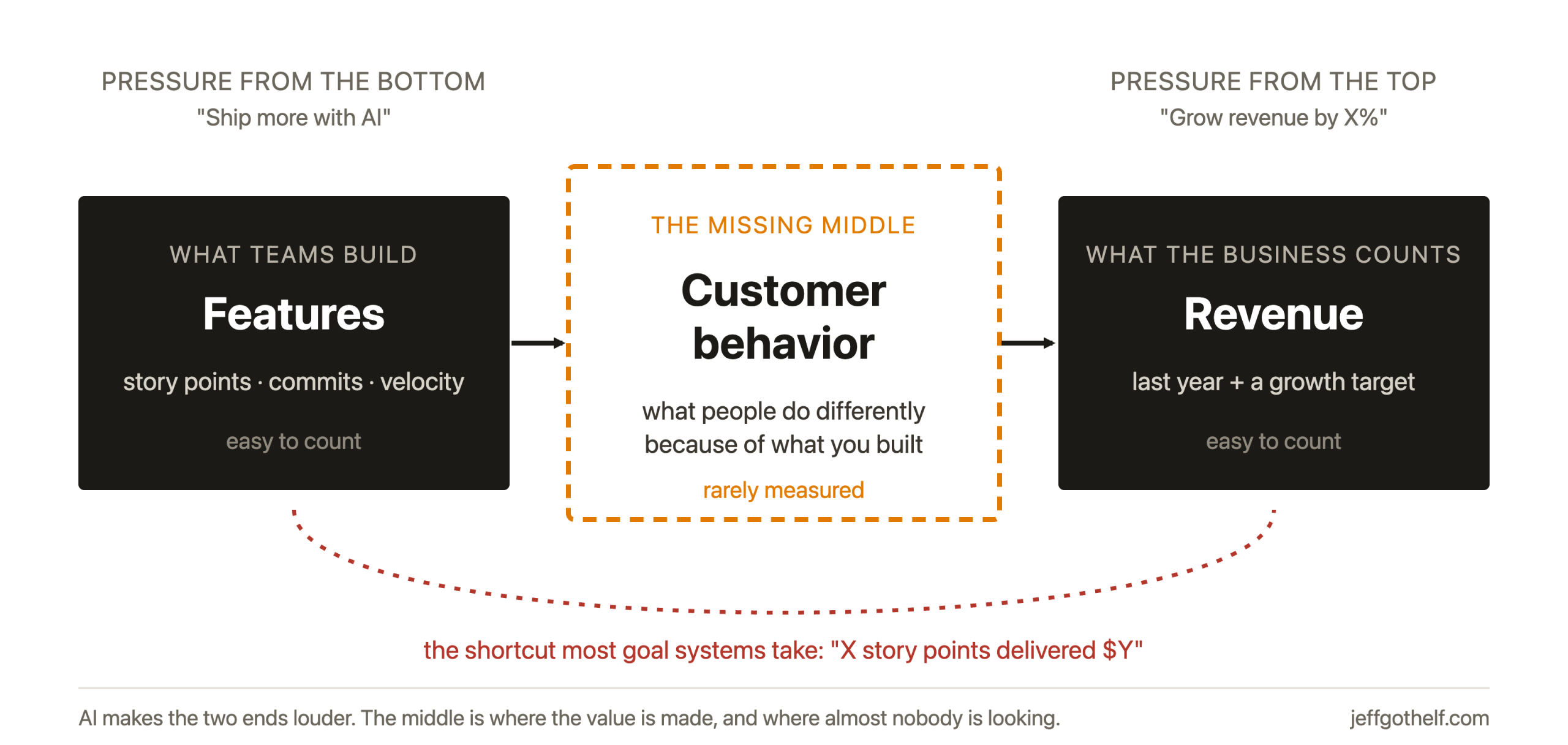
We’ve been having some fascinating conversations with our clients recently about AI. We normally work with large, enterprise-level organizations. So, while there’s a lot of talk about how AI is changing how companies work, our clients, to be polite, take their time adjusting and adapting to new technologies. AI is no different. In one such conversation, an organizational leader at a multinational firm was asked to quantify the ROI of their AI investment with several engineering leads on the same call. The conversation quickly veered into a discussion of how many more story points AI has helped them deliver. The group then tried to figure out exactly how many more dollars to attribute to each of those story points.
The cost of AI and the advertised improvements that come with it are driving up revenue expectations in ways that assume exponential increases in team productivity and efficiency. The pressure is being applied at the top of the organization and at the bottom. The middle, however, is the part where features actually connect to revenue. This is the connective tissue between, “Hey, you know what would be cool?” and “Look at that, we made more money!” And it’s increasingly being ignored. Let’s look at why.
Revenue targets and story points – two goals that seem connected but are not
Most companies are used to working with two clear metrics – revenue and story points. One measures the health of the business. The other measures the productivity of the engineering organization. Leaders get last year’s revenue goals plus an additional percentage to grow into in the coming year. This is a familiar language and an expected target. On the other side of the company, product development teams get roadmaps, list of features and shiny new AI-powered tools. Their measure of success is also familiar. Their bosses are looking for velocity increases, story points shipped and number of commits to go up by a totally made-up percentage as well.
These numbers have been with us for so long because they are easy to measure. And if something is easy to measure, it’s easy to manage. AI makes counting both ends easier than ever. What AI hasn’t given us, yet, is a reason to change either the language we’re using to measure our productivity or a reason to focus elsewhere. At least, that hasn’t become obvious yet in the enterprise. And yet, given the ability to produce so much more quickly these days, it’s exactly the part of the conversation that’s missing from making AI usage more valuable and accountable.
Customer behavior is the connection between features and revenue
There is a legendary clip from South Park called Underpants Gnomes (NSFW language). The gang follows a gnome to learn about their business of stealing underpants. The gnome tells them that “Phase I is to steal underpants.” “Phase III is profit.” Phase II? No one has any idea. This is exactly the situation AI has exacerbated and made obvious now. Everyone seems to be clear on Phase I, making more things. And Phase III, making money, is how a business measures its overall health. But in between there is something that happens to turn underpants (features, in our case) to profit. That thing is human behavior. What, if anything, do the people that we serve do with the features we’ve built for them?
The frustrating part is that leaders in the enterprise know this. It’s just that in most organizations these metrics either don’t exist at all or there is no room to report and track them. In other words, no one is asking for them given the extreme focus on revenue and productivity. Some are trying though. One of the leaders we work with told us they asked their team to at least connect their shipped feature points to a specific revenue number. It’s an attempt and one that makes the problem even clearer. The connection goes straight from output to money. This means there is no clear attribution between which feature impacted which revenue metric. And, in the enterprise, revenue lags far enough behind production that the connection is even less accurate over time to provide quarter-by-quarter steering of the team.
How to put the behavior layer back into the goal system before AI makes the gap too expensive
Using AI to produce more features faster only guarantees you now have a faster feature factory with no clear sense of whether what you’re building has any value to your customers. We’re just building the wrong things faster. There is a push too now to “just build it and ship it” and “we’ll learn in production.” This assumes that your customers are even looking for these features and that they have the time to explore each one that you ship. (Hint: they aren’t and don’t). The other assumption here is that the team can track usage of each feature, get enough data on each one to inform a decision and then go back to kill or pivot the ones that didn’t perform well. And, if you work in the enterprise and believe that last sentence to be true, I’ve got a bridget to sell you 😉 .
Here’s the catch-22. Expectations are now coming down on teams to use AI to be more productive. The assumption, as I mentioned above, is that this newfound productivity will magically drive profitability. When that profitability doesn’t come, leaders then put further pressure on product teams to produce even more so they can justify the AI investments they’ve made to date. Rather than ask why something didn’t deliver the expected results, which would lead to a discussion of customer behavior (outcomes), they will push to make more stuff. It comes down to leaders still asking the wrong question with AI. It’s not “How will AI make us work faster?” Instead, it should be, “How should the work change now that we have it?”
Here are three things to put in place to help connect features to revenue as AI increases the pressure to amplify both:
- Push to add two or three customer behaviours to every revenue target. Work with your leaders to answer the question, “Before these features make us money, what will our customers need to do?” Track these alongside the revenue metrics.
- Report AI success based on customer impact, not how much more work your team produced. Did teams learn faster which features change behaviour, and did they stop building the ones that don’t? Did we notice an increase in positive customer engagement as we delivered more features? Why or why not?
- Change the conversation from “what shipped” to “what changed for customers?” It’s easy to drift back into reporting output week after week, especially if that’s what’s being asked for. This happens after every training program ends. An easy way to get the customer-centric focus to stick is to keep asking about the impact the work is having on customers. Then, it’s up to you to visually connect the dots for your stakeholders on how that behavior affects revenue.
AI will make the top and the bottom of product work more visible than ever
We simply cannot inundate our customers and our internal teams with an endless stream of AI-produced features. There is no reason to do so. It’s expensive and leaves us with code that we now have support and maintain forever. AI excels at exposing data like revenue and the countable parts of product development like lines of code and story points. Where we need to inject humans back into the conversation is that middle layer. Understanding why we’re building something, who we’re building it for, what we expect them to do with it and how that behavior drives business results is, to be honest, product management 101. If we ignore that part of our job, we might as well abdicate it all to the robots and hope for the best.




Leave a Reply