Years ago Reid Hoffman was quoted as saying, “If you aren’t embarrassed by the first version of your product, you shipped too late.” He was right then. He’s even more right today. It’s worth contextualizing, though, that he was speaking about and to startups. What about in the enterprise? Legal, risk, compliance, and many other dependencies, not to mention brand promise and reputation, keep big companies working hard to not be “embarrassed” by the first version of their products. As AI increases every team’s capacity for production, waiting for certainty before committing to launching something becomes increasingly risky. Here’s how to take advantage of AI to normalize intelligent decision-making under increasing uncertainty.
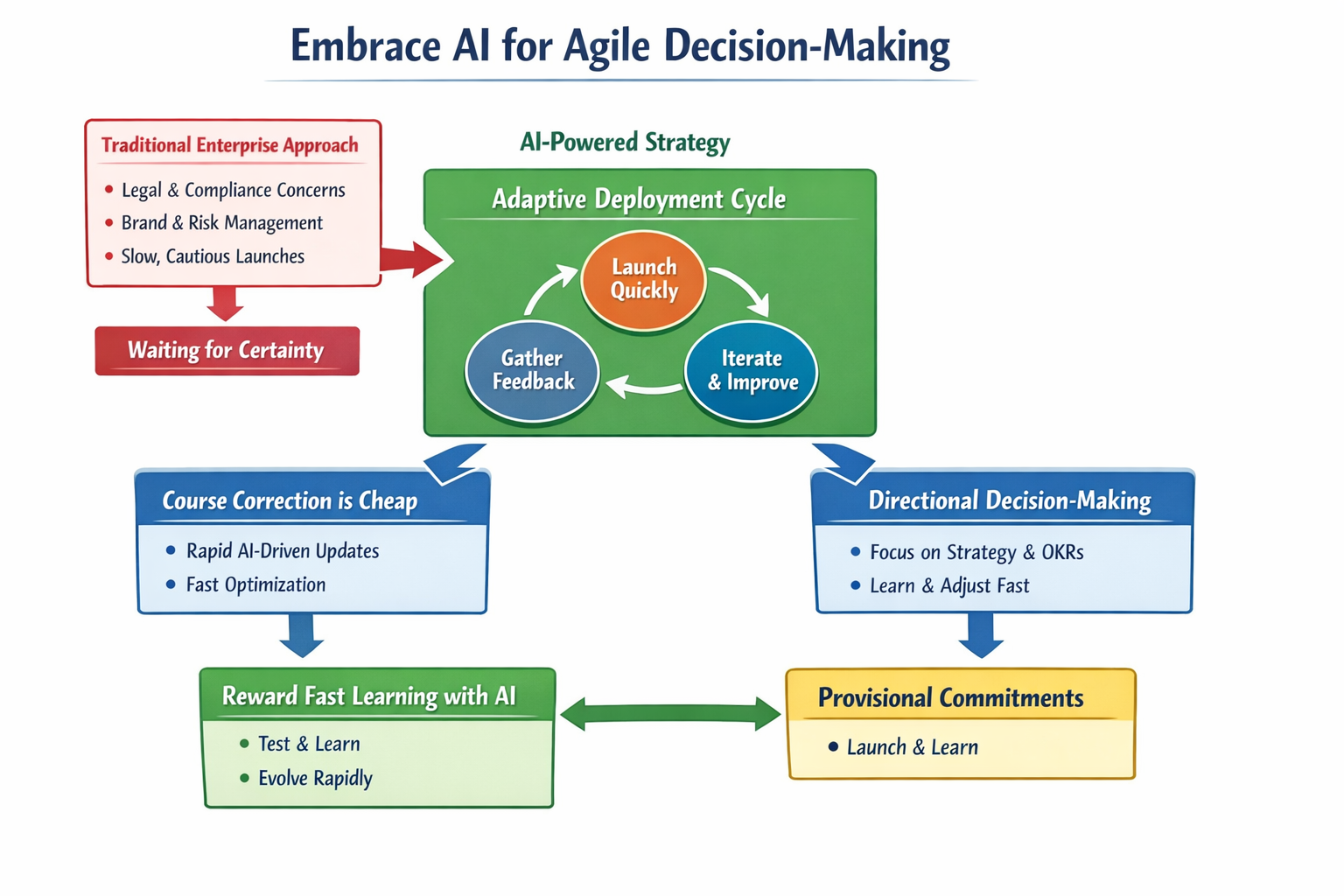
Course correction is cheap
Ever since continuous deployment, testing and integration came into regular practice, course correction has been cheap. With AI in the mix it’s even cheaper. As we begin to deploy, bit by bit, new ideas to market and feedback begins to roll in, optimizations can roll out even faster than before. How? Humans don’t have to write all that code anymore. They have to review and approve (I still don’t think we should give the bots ALL the control) the work but the AI coding agents can get the fixes ready in minutes. The cost of deploying the feature is reducing quickly allowing the commitments we make to be provisional. This is possible because the cost of course correction is dropping at a similar rate.
Decisions don’t have to be perfect, just directional
I’ve been advocating for years for fast learning and continuous improvement. In my opinion it was never an optional tactic but many large companies pushed back because of the bureaucracy those large organizations tend to create. Today, that is a recipe for obsolescence. The decisions leaders need to make today should be provisional. They should be aligned towards a clear strategy and human-centered goals (yes, like OKRs). Those should be the guiding principles for decision making rather than a “can we” vs “should we” endless debate about another tweak that may or may not improve the user experience. As long as the logic behind our decisions is customer-focused, the decisions can be undone as soon as we get something to market and data back on its efficacy. AI makes this exponentially faster and more accessible.
Reward fast learning with AI
There’s no excuse for waiting until something is perfect before shipping it anymore. It doesn’t mean you have to be embarrassed by the work your teams are shipping. It does still have to be reflective of your company’s brand and reputation. It just has to have the permission to function as a learning tool. Building with AI makes that easy, fast and relatively much safer than ever before. And it’s these provisional decisions that can be updated and undone that will ultimately get rewarded in the market.




Leave a Reply