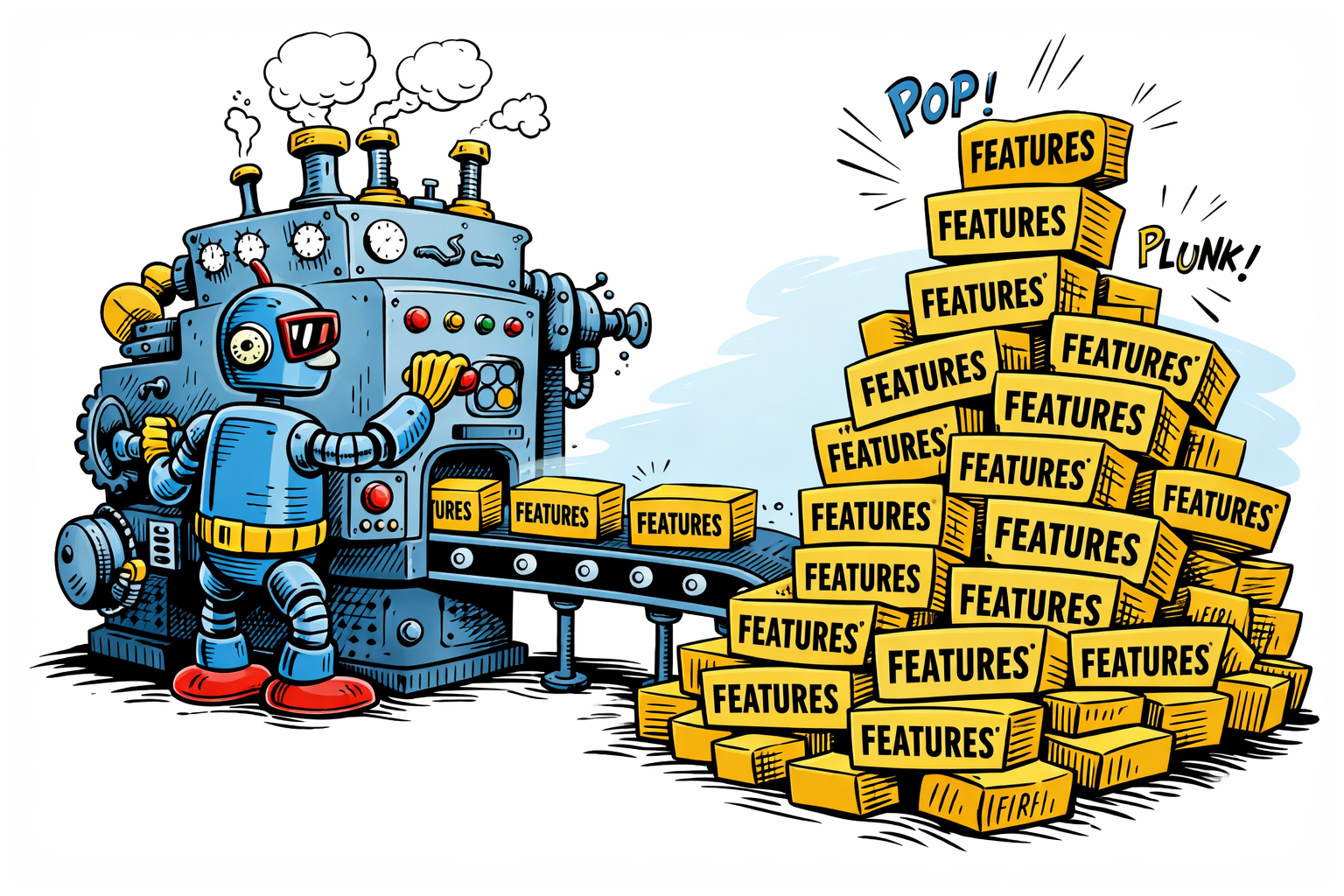
Before AI stormed the castle, there was a clear and consistent risk in digital product development – writing and shipping code. The ways of working, management structures, incentives, processes, deliverables and approval cycles were designed to mitigate the risk of building and launching the wrong product. Every consideration was made to “protect” engineering teams’ capacity, predictability and delivery efficiency. Why? Because software development was expensive. It took a lot of people’s time to design, code, QA and ship new features to customers. If it hasn’t already, AI will eliminate those constraints and hugely reduce the cost of writing bug-free, production-ready software. When execution is cheap and fast, the software development bottleneck moves to clarity and outcomes. In this new reality, sensing and responding is no longer a learning approach but a risk-reduction system.
Lower Development Costs Mean Higher Stakes, Not Just Higher Productivity
I recently saw Henrik Kniberg give the opening keynote at Scrum Day Europe in Utrecht, Netherlands. If you haven’t heard of Henrik I urge you to look up his body of work, especially his Youtube channel. He shared a story about how he was at a cafe and got a Slack message from a bot that had identified a bug in the feature he was working on. The bot proposed a solution and asked if it should fix the bug. Henrik agreed. The bot went to work and 10 minutes later a fix was deployed to production. Henrik hadn’t moved from his seat at the cafe.
This is the future. Except it’s not futuristic. It’s happening right now. Sure, the scope of the bug fix wasn’t huge in Henrik’s story. Soon though, this will be the reality for the majority of software development. Humans will prompt. Bots will react, offer options and proactively suggest alternatives and fixes. Amazing, right? It is amazing. It’s also highly risky because it exponentially increases the pace with which we can deploy features to our customers. Bots don’t need to take breaks or sleep. They can just keep writing and deploying code. It doesn’t mean it’s valuable code. It just means it’s code that will “work as designed.” In other words, the risk is no longer how will we consistently ship bug-free code but rather how do we ensure what we’re shipping isn’t heaping crap on top of crap and, instead, making our users more successful?
Why Product Discovery Is No Longer Optional in an AI-Powered World
For years we (me, Josh Seiden, Teresa Torres, Melissa Perri, John Cutler, Marty Cagan and dozens of other practitioners and thought leaders) have been touting the benefits of continuous product discovery as an exercise in learning where to best point our teams next. In an AI-powered world where delivery is cheap, learning is no longer optional. It is a fundamental risk-mitigation tactic ensuring our bots are producing something valuable in the world rather than simply just “more features.”
For those same amount of years corporate leaders have treated product discovery as a nice-to-have and all too often optional part of the software development process. This is no longer a viable option. If we’re going to point our AI’s at specific problems and solutions we need to ensure that these are real problems for real customers. We need to ensure that our measure of success changes.
How to Reshuffle Your Product Team’s Priorities for AI
When producing a feature takes minutes instead of months, software delivery becomes a non-event. How will we know we’ve met customer needs in a meaningful way? How will we even know what those customer needs are? That’s where the risk lies now.
The good news is we can use AI to supercharge our discovery process as well. We can synthesize customer insights faster. We can create prototypes faster and we can validate our OKRs in half the time. The other bit of good news is that the people we need to do this work are already on our teams. They’re the product managers, designers and researchers who have been there all along. The only catch is that we now have to take this part of the process even more seriously. Companies that embrace this reprioritization will thrive in the AI age.




4 responses to “AI Made Execution Cheap: What ‘Good Work’ Looks Like Now for Product Managers”
With AI taking over many of the time-consuming aspects of development, it’s interesting to think about how the bottleneck has shifted from execution to clarity and outcomes. As execution becomes cheaper, I can see teams needing to focus more on aligning the product vision with real user needs—leading to a greater emphasis on strategic thinking and collaboration.
[…] AI made execution cheap. The cost of producing anything from a prototype to production quality code is extremely low. This reduces the risk of sending engineering teams off on a wild goose chase only to change direction on them as new information becomes available. That constant course correction was costly as was producing the artifacts necessary to get those engineering teams started. Sign-off, approval and permission were needed so that someone was accountable for sending a software development team down a specific path. This is no longer the case. […]
The good news is we can use AI to supercharge our discovery process as well. We can synthesize customer insights faster
[…] been writing for the past few weeks how the cost of engineering new software is dropping significantly. I’ve […]