I spent some time with my brother over the past couple of weeks. He’s an urban planner. He doesn’t work in tech and he most certainly does not write code. It turned out, however, that he’s been sitting on a digital service idea for twenty years. It’s a sort of stock exchange for non-financial assets. And he has always believed that one day the technology and market appetite would catch up to his vision.
Last weekend, we decided to find out if that day had come.
We sat down together with Claude Code and spent about an hour vibe coding a prototype. We described the concept, iterated on the output, tweaked the interactions, adjusted the visualization. After sixty minutes, we had something interactive. Something that actually showed his idea moving on a screen.
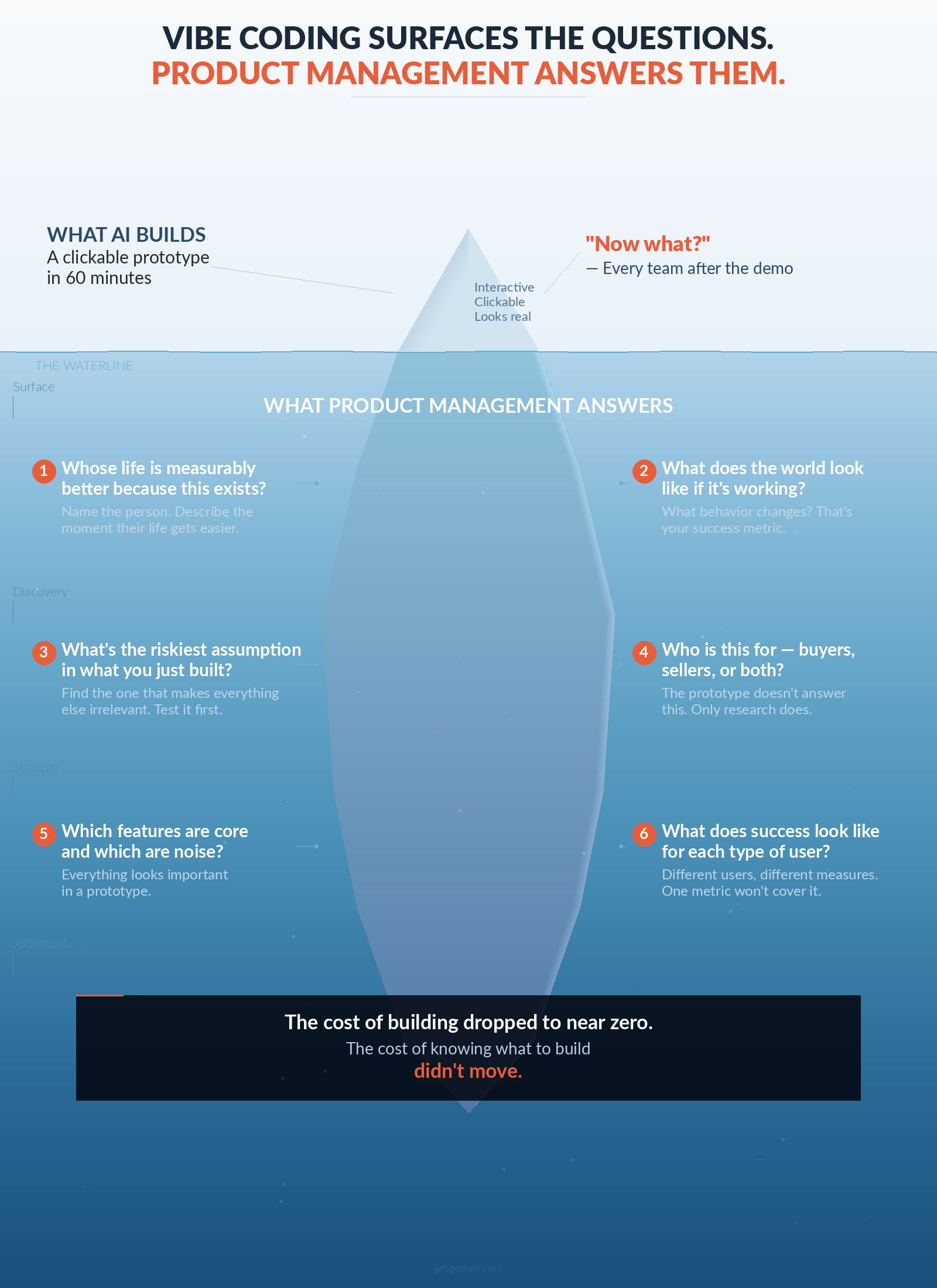
He leaned back, looked at it and then at me, and said: “Now what?”
He was serious. He genuinely didn’t know where to go next.
The prototype answered nothing
What we’d built in an hour was not a product. It was a clickable prototype that generated 1000 new questions.
- How should the exchange algorithm actually work?
- Who is this for — buyers, sellers, or both simultaneously?
- What’s the right interaction model for someone who’s never thought about this before?
- Which features are core and which are noise?
- What does success look like for each type of person using it?
- Etc…
The AI tools we used to create the prototype were extraordinary. They made it trivially easy to go from his idea to interactive artifact in less time than it takes to write a spec. That is genuinely remarkable. But what they couldn’t do was answer any of the questions the prototype raised. This is the true power of vibe coding – to surface the questions that need to be answered about a new product, feature or service. It’s good product management work that’s required to answer them.
This is the AI productivity trap
Every team I work with right now is building faster, shipping more and generally making more output. And a surprising number of them are confused about why it doesn’t feel like progress. It doesn’t feel like progress because speed without direction is just accelerated uncertainty. The “now what?” problem isn’t unique to my brother. Every team being urged to deliver more interactive versions of their ideas faster is facing it. And this question doesn’t get smaller when you ship faster. It gets bigger.
My brother’s prototype session compressed twenty years of “I wonder if I could build this” into 60 minutes. What it revealed when it was “complete” was the full weight of the actual opportunity he was trying to exploit. This had nothing to do with whether his idea could be built but whether the thing he built solved the right problem for the right person in the right way.
That’s product discovery and product management. That’s the work. And it’s the part AI doesn’t do.
Three questions for after the prototype
Whenever a team gets to “now what?”, I give them three questions to start with.
Whose life is measurably better because this exists? Name the person. Describe the specific moment when their life gets easier, their work gets done faster, or their decision gets made with more confidence. If you can’t name that moment, you’re not ready to build the next feature.
What does the world look like if the product is working? Not “the product is live” or “users are signing up.” What behavior changes? What does the person do differently the day after they start using this? That’s your success metric. Everything else is a proxy.
What’s the riskiest assumption in what you just built? Every prototype is built on a stack of assumptions. The job after the demo is to identify the one assumption that, if wrong, makes everything else irrelevant — and go test it immediately.
My brother and I spent the next hour on those three questions. We didn’t touch the code again.
Vibe coding is a gift
I don’t want to overstate the risk here. What happened last weekend was genuinely exciting. A person with no technical background turned a twenty-year idea into something real and interactive in an hour. That is an extraordinary thing. But democratizing the ability to build something is not the same as democratizing the judgment required to build the right thing.
The “now what?” question has always been the hardest one in product development. AI didn’t solve it. It just forces us to face it sooner.




3 responses to “Vibe coding surfaces the questions. Product management answers them.”
[…] https://jeffgothelf.com/blog/vibe-coding-surfaces-the-questions-product-management-answers-them/ […]
[…] Source: Vibe coding surfaces the questions. Product management answers them. […]
[…] I’ve been to a lot of meetups about AI in the last year. Across all of those there’s been a common refrain that gets repeated by the experts and the newly empowered noobs alike. “If you don’t know how to get what you need out of your AI tool, just ask it.” It’s one of the most powerful aspects of the AI revolution. You can’t ask a hammer how to build a cabinet. You can ask Claude how to build the web app you’ve imagined for the last 20 years. […]