This week’s blog post was inspired by the webinar we did last week with Barry O’Reilly. Barry is a long-time friend and colleague. Besides being an accomplished author of 3 amazing books, Barry is the co-founder of Nobody Studios, an executive coach and a keynote speaker. You can learn more about him here.
While every organization, it seems, is investing heavily in AI tools and integration, very few are seeing the value they expect across the organization. There are no shortage of hot takes on this topic across LinkedIn, Substack and endless email newsletters (ours included). We thought we’d take a slightly different approach to the topic in this article and base our argument on Barry O’Reilly’s new book Artificial Organizations: Build Better Judgment, Speed, and Results with Human and Machine Intelligence, which examines why adoption and activity so often fail to become measurable outcomes.
In a recent webinar we did together with Sense & Respond Learning co-founder Josh Seiden, Barry shared a set of numbers that while concerning are also not surprising. Enterprise AI deployment increased roughly 400% during 2024–2025, yet meaningful returns remain concentrated in approximately 12–18% of companies. MIT’s NANDA research similarly reported that about 95% of enterprise GenAI pilots produced no measurable business value or sustained P&L impact, with only around 5% scaling into production. These findings do not prove that the technology is failing. They suggest that most organizations are treating AI as a tool implementation rather than redesigning how people think, decide and work.
Why AI amplifies the way you already work
AI, in the way most organizations use it today, is very good at amplifying whatever you already do, which means some of the benefits organizations are getting is genuinely useful. The rest of it, however, is just more of what you are already struggling with creating teams drowning in AI-generated documents nobody has the time nor judgment to actually read, react to and prioritize.
At Nobody Studios, Barry’s AI venture studio, there was a clear shift in founder behavior once ChatGPT arrived in 2022. The idea submissions from these aspirational founders went from clearly handcrafted pitch decks to a kind of data-room dream where every artifact was present and beautifully formatted. Yet one or two follow-up questions showed there was very little real thinking underneath these shiny decks because this new capability had been used to outsource a lot of founder thinking instead of changing the way of working itself.
The traits, tasks and tools model, and why the order matters
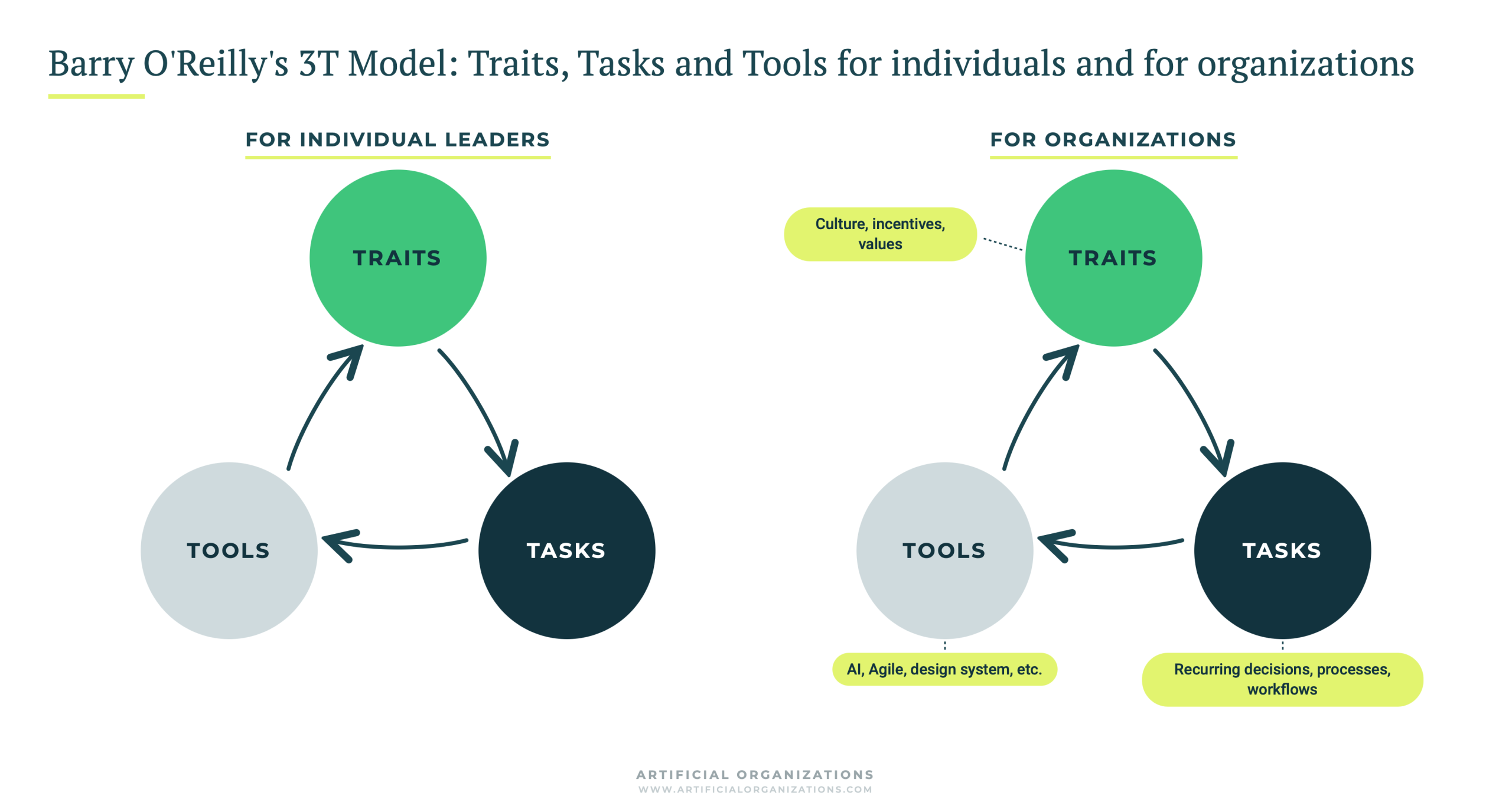
In Artificial Organizations, Barry introduces the Trait–Task–Tool (3T) Model. Most people run it in reverse: they start with a tool and ask whether they should use Claude or ChatGPT, then search for a task to apply it to. The last thing they consider is how they naturally do their best work. The 3T Model restores the sequence: start with your traits, identify the high-leverage tasks where your judgment creates value, and only then choose tools that amplify both. In Barry’s terms, this is not productivity sequencing. It is judgment infrastructure design.
His own example made the point clear. Barry is dyslexic, and for years he assumed writing a book meant doing what writers apparently do, sitting by a fire in a velvet jacket typing out pages. He made very little progress. When he looked at how he actually does his best thinking, the answer was talking. So he hired a journalist to interview him, recorded the conversations with an AI transcription tool, and had that edited into chapters. His trait was talking, his high-leverage task was creating content, his tools were the human and the machine together. His productivity spiked from one chapter per week to about 4 hours per chapter. The breakthrough was not the technology. It was redesigning the work around how he actually performs at his best.
Scaling traits, tasks and tools to the whole organization
The 3T Model begins at the individual leader level The question I most wanted to ask Barry was whether this scales from the individual up to the culture of a company. His answer was that transformation is never something you do to an organization all at once, it is collective individual change, and if we are going to run his model at that level we have to be clear about what each of the three Ts becomes.

One way to interpret an organization’s traits is as its behavioral DNA , and by that I mean how work actually happens rather than the values printed on the careers page. How do decisions really get made here? How do our meetings actually run? How does information actually move between teams? What do we reward? What do we avoid? Those real behavioral defaults are the organizational version of Barry’s “how do I do my best work?” Unfortunately these are also the things a transformation effort skips straight past on its way to buying a new shiny tool or process (remember Agile?).
At an organizational level, the highest-leverage tasks are the recurring decisions where collective judgment creates the most value . This could be the weekly business review, the prioritization call, the go or no-go meeting, rather than the busywork of producing documents to feed the next QBR. When a webinar attendee asked why Barry frames tasks around judgment instead of activity, his answer was that people are paid to make decisions, not to generate volumes of output, so the tasks worth redesigning around are the ones where a real call gets made under uncertainty (i.e., when judgment is actually put to use).
The tools, including AI, come last. Their purpose is to support the behaviors, decisions and workflows you have deliberately chosen to improve. Get the order right and AI can strengthen decision velocity and decision advantage: how quickly you move from question to insight to decision to action, and how informed and context-rich those decisions are. Get it wrong and you may spend thirty dollars per license across a thousand people simply making your worst habits faster. That is the difference between installing tools at the edges and redesigning the core.

How new behavior spreads from one person to a whole company
So where do you start? Most organizations get stuck here because the choices are quite literally infinite. There are so many workflows and micro-decisions being made on a daily basis it’s hard to know where to begin trying out this new approach. In our webinar, Josh made a point that you can treat this kind of change the way you would treat a new product development initiative. You form a hypothesis about a behavior you want to shift, identify the traits, tasks and tools to introduce into this workflow, try it for a short period, run the retrospective to see whether it is producing that behavior, and then kill, pivot or persevere. With this approach, culture change stops feeling like a mandate and starts feeling like a series of small experiments you learn from daily and then scale. Personal workflows become team habits; team habits become products and processes; and, when the evidence supports it, those systems can reshape business models and culture.
If you are the person who has to make this real, and often that is a team lead or a middle manager rather than whoever signed the AI contract, do not try to install a new culture. Sure, think big, but start small (as Barry likes to say). Pick one recurring workflow that matters. It could be a decision or a genuine point of friction and then ask these two questions: what does this look like when it goes well, and what are people doing differently when it does? Once you’ve had this conversation, name those behaviors explicitly. Design a new way to achieve those outcomes (this is your hypothesis) and only then bring in the tool that amplifies the behavior you want.
For example, you could take something as simple as the idea that meetings are far more productive, effective and often shorter when they have agendas prior to their start. The desired result is a 75% increase in the number of meetings that start with agendas. You could then decide that the meeting organizer has to reach out to all the attendees and confirm their expectations for the meeting and then compile those findings into an agenda shared across all attendees. Now, the team decides to bring a tool (could certainly be AI) that queries meeting attendees in advance, summarizes findings and ships a draft agenda to the organizer 24 hours ahead of the meeting to verify, edit and distribute.
We suspect the organizations that see real ROI from AI over the next couple of years will be the ones that were willing to look honestly at how they actually work before deciding what to automate, rather than the ones that simply bought the most licenses. Pick one workflow this week. Apply Traits → Tasks → Tools in that order. Define what better means, run a small experiment, and measure what changes.
P.S. — You can watch the entire webinar with Barry here. And you can buy Artificial Organizations here.