Last year I wrote a short piece here about how to set OKRs to measure the success of your OKR deployment. In that piece I argue that implementing OKRs (or any new way of working) is an output. The goal is to positively impact the behavior of the people using that framework. Therefore the measure of success is a meaningful improvement in how our teams are working once OKRs are in place. Recently, working with a client, we went through this exercise and ended up with an OKR for their OKR implementation that landed at two different levels. Both took the above idea to heart however each one landed at a much different level of specificity. Let’s take a look at these two options.
Option 1: Is the OKR adoption taking hold?
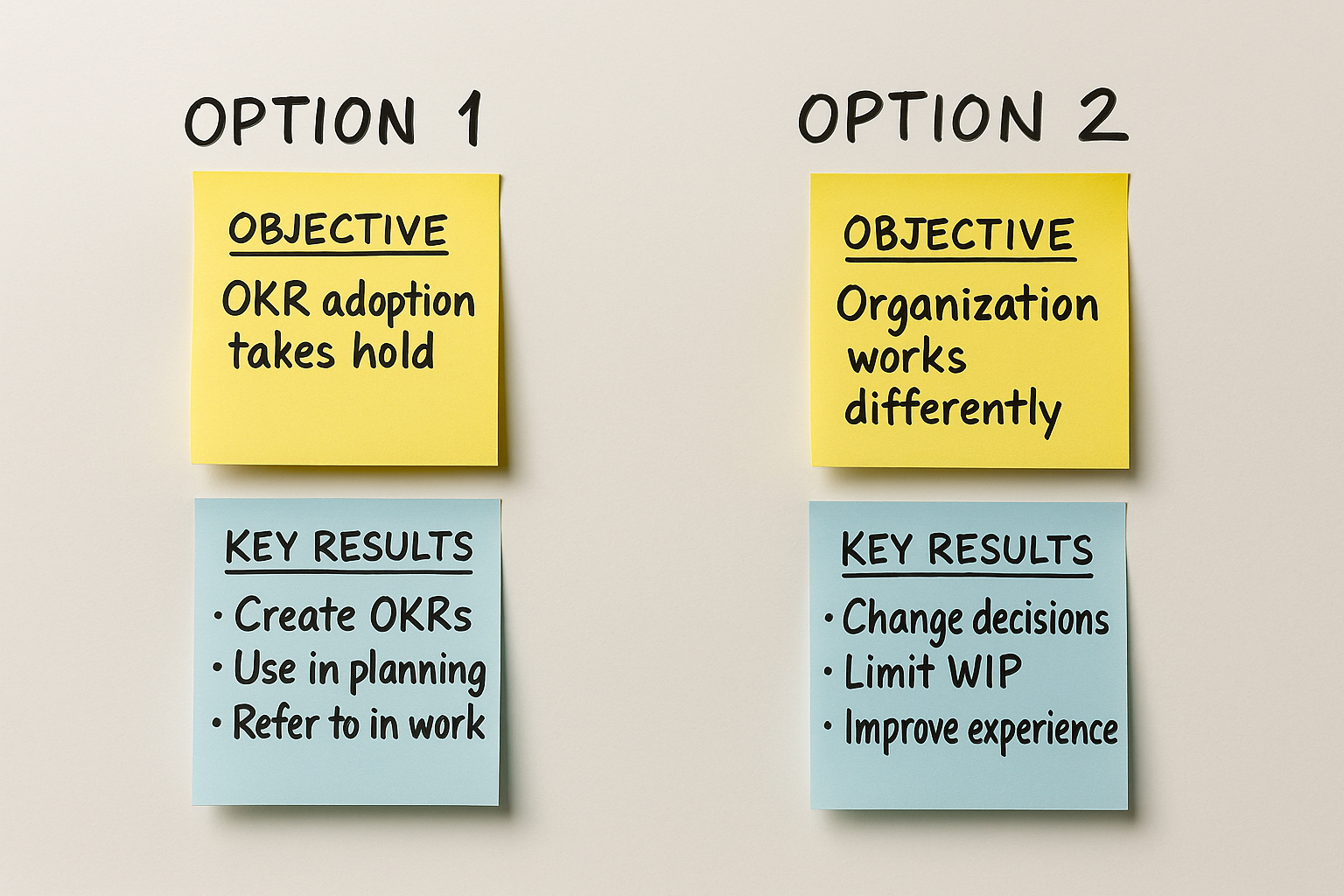
One way we approached setting a goal for our OKR implementation was to get tactical. We wanted to measure whether OKRs were actually being written and used. Now, normally this would come across as a task or activity to check off a list – an OKR anti-pattern we regularly coach teams away from. However, if your organization is not using OKRs at all, measuring the creation and integration of the new goals into teams’ workflows makes for a good OKR.
In this case, your objective would focus on making OKRs easy to understand, accessible and clearly valuable. Your key results would then focus on whether or not your teams were:
- Creating well-structured OKRs
- Incorporating them into planning sessions
- Discussing them when making decisions
- Referring back to them as justification for changes
This type of OKR doesn’t actually measure whether OKRs are adding any value. You’re simply measuring that the idea is being incorporated in day to day work. This can be a good place to start but once your teams are good at the basics, it’s time to move on to different goals.
Option 2: Is the organization working differently as a whole?
This is more inline with what the article from last year was describing. In this situation we’re not measuring the acts of writing, debating, agreeing on and integrating OKRs into your day to day work. Instead we’re taking a bigger look at the whole organization and addressing why we brought OKRs in in the first place.
Your objective in this situation would look to a future state where the entire organization is aware of the goals, is more customer centric and is clear on why they’re working on each item. The key results would then focus on how funding and prioritization decisions are made, how much work in progress there is and the impact the company is having on the customer experience. This OKR doesn’t mention OKRs at all. Why? Because, in this scenario OKRs are very much the output. If they don’t change behaviors towards the desired key results, the organization should move on to a different goal setting framework.
Which way to go?
If your company has never used OKRs before I would go with Option 1. Make sure the OKR work is getting done and integrated into how the teams work with each other. If you already have OKRs in place or have tried them before, I would try Option 2. You have bigger goals in mind ultimately and OKRs may get you there. If they don’t, work to understand why and then adjust the OKR rollout or try a different approach.
Good luck.