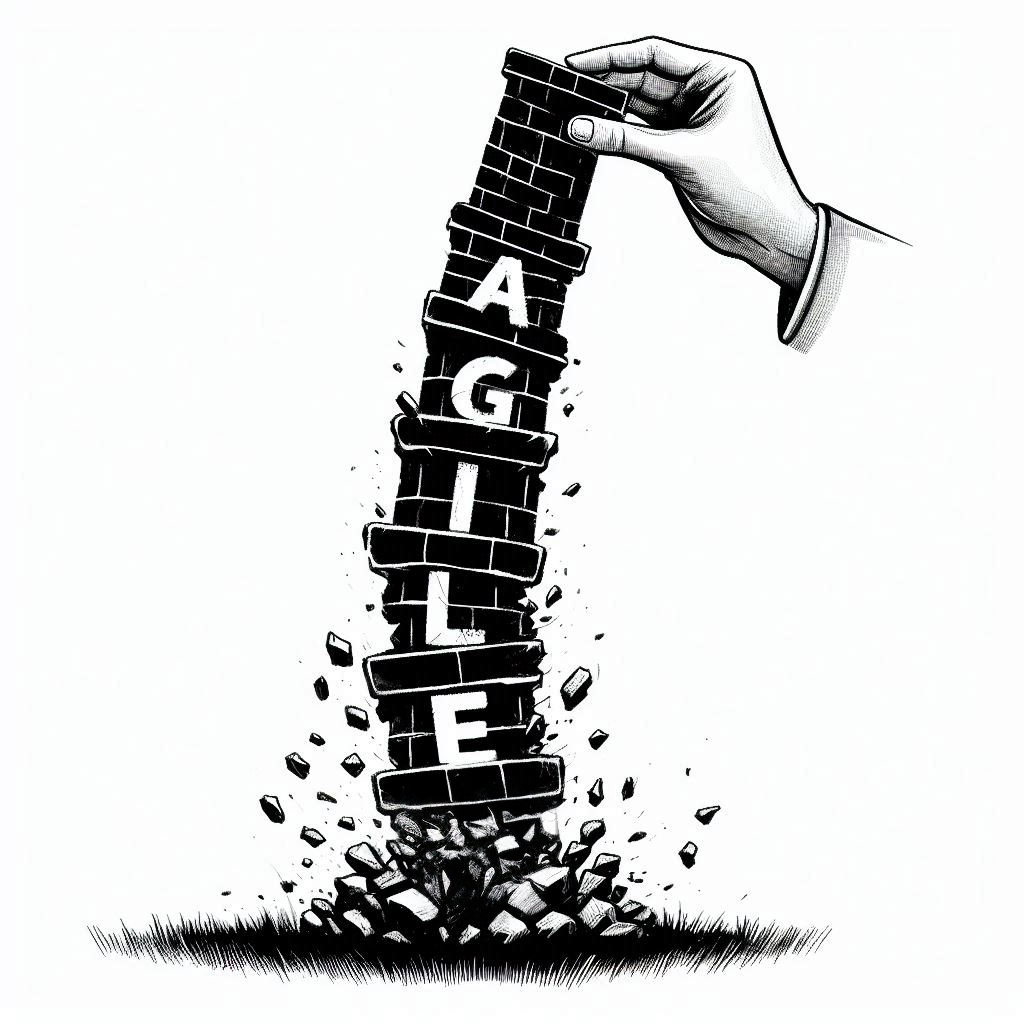
Every empire falls, they say. Over the past 20+ years Agile rose to prominence as the way to run, at first, your software development teams and then your entire organization. Books, courses, training companies, certifications, frameworks and endless diagrams flooded the market. Conferences were packed with everyone (me included) clambering to learn more about these revolutionary ideas that were going to save us all from the inefficiency of waterfall style management. However, since late 2023 there have been signs that the business world’s fascination with Agile is waning. Is Agile finally over?
Saturation does not equal maturation
Just because a high percentage of a population has been exposed to an idea doesn’t mean that idea has been internalized and ultimately put to good use. This is certainly true of Agile and the business world. If you took a room full of executives and asked them, “Which of you run your company in an Agile way?” I guarantee you that 99% of the hands in the room would be up in the air. Dig a little deeper though and you’ll find that, yes, Agile is being used in these companies but very few of them are seeing any real benefits. Why is that?
Consultants like me will tell you that there have been “a lot of bad Agile implementations.” And we’d be right. There have been. These failed transformations have soured many individual contributors and middle managers on the potential benefits Agile offered. In their minds, “Agile sucks.” In addition, there has been a lot of resistance from leaders to change how they work to accommodate greater agility in their teams. They may not come right out and tell you that, but ask a few pointed questions and you’ll see the patterns emerge.
“We’ve implemented SAFe so we can predictably deploy features every 6 weeks no matter what.”
“We, on the business side of things, define the product for the development teams so they can just carve it up into stories and keep shipping velocity high.”
I suspect this sounds familiar to most of you. Agile has saturated the market. However, exposure for most organizations fell at the surface level. Let’s change our language, perhaps our furniture in the office and that should be it for our Agile implementation, right?
Agile is at a critical point
Despite the seemingly unavoidable influence of Agile on how we run our businesses and teams today, there are still organizations who are now or will soon be new to this. I feel like we, those of us who help shape the narrative around these ideas and those of us who put them into practice, have a responsibility to these organizations. Forcing a framework on an organization and then policing it to a point where it becomes just as rigid as the framework it’s replacing is going to continue to fail.
Instead, rather than focusing on the strict implementation of an idea, let’s focus on the benefits and desired outcomes we hope to get from it. Rather than enforcing an idea like “2 week sprints” let’s ask our teams to be able to “react to any new data point or insight from the market in 2 weeks or less.” Instead of saying, “you must complete your user stories in a specific format and enter them into this tool” let’s ask the teams to “reduce the number of handoffs between disciplines by half.”
The difference here is, perhaps not surprisingly, outcomes over output. Rather than telling people how to do their jobs, work with them to set the goals for a process that would make them and the company more successful. Measure success based on improved team behavior rather than adherence to a set of rules. Instead of Agile, push for agility. In that sense, Agile is never really over. It’s just transforming into what it should have always been.




28 responses to “Is Agile over?”
Jeff, I would the same thing for LEAN, Six Sigma, Kiazen, Design Thinking, and traditional waterfall Project Management plus a whole score of other methodologies. Ever been in the room with a room full of “Project Managers” and no one knew what a Gantt Chart was, much less a milestone? It is good to add “tools to your toolbox”, but I feel it’s like most people studied in college, Did they even open the book? How much do they even remember if they did? Also like remote work, it’s about trust, transparency, and control. As you stated, “In addition, there has been a lot of resistance from leaders to change how they work to accommodate greater agility in their teams.” I would this is much more than Agile?
Maybe a large % of A(a)gile saturation may be more of following the herd mentality, and not truly owning the outcome based focus towards value? Typically startups and teams that own the product and outcome may beore effective compared to teams that are made to follow a model (where the mindset is still to work the hours}
Agile states “Responding to change over following a plan”. It’s okay to switch stuff up mid-sprint if you are following agile. You don’t even need sprints to be agile. You just have to be shipping something functional occasionally. Agile means if you want a 3 week sprint or 5 week sprint for the next iteration then that’s perfectly fine.
Companies often lump agile and scrum together but they don’t have to go together and a really strict scrum master can break agile.
The problem with Agile implementation is the team concept doesn’t mesh with top down management. That and it’s difficult to get the customer to be involved and prioritize the backlog. Finally, the Agile mindset is not easy to instill in people. They “follow an Agile methodology” but don’t get it’s a framework to help people follow the concepts of the Agile manifesto.
Agile as said it sucks…it stands in its own way and never understand business how it works…Actually Agile has reduced the output, increased cost by bringing in more non-value members to team and lots of value time lost.
I believe the real issue is that Agile has gotten big enough that everyone agrees that is can provide some great advantages in the market. but many trying to “take advantage” of the benefits of Agile, MVPs; quick response to market forces; etc, are not willing to do what is required to achieve those advantages. Like letting others take control and make decisions when they work on a task. Do you really think any of these corporate big wigs truly understand the Agile Manifesto?
A so called “Agile transformation” doesn’t result in business agility (whatever that is!). Agile has never been the silver bullet, it’s a set of values and principles.
Whichever framework you hang your hat on, is a journey of change. Some frameworks are better than others, some Agile techniques are easier to implement than others. None are actually easy!
Agile could be replaced with ‘lightweight’ as was the original intention but most implement replacements for existing broken business paradigms with Agile. Agile Project Management is a case in point.
Agile works, Scrum works, XP works, Kanban helps.
Stories and it’s baggage often doesn’t help neither does Atlassian with it’s own brand of Agile often acting as a constraint not a benefit. The list goes on with implementations not understanding the business, it’s people, Empiricism then Agile in that order.
Agile was always a misunderstanding of traditional project management implemented by people who think they have to reinvent everything. Unfortunately, compared to all other life cycle and work management processes thst came before, agile had nothing there. I had 4 classes on this stuff, designing these system… yet agile tried to do it with like a couple vague sentences describing a misguided philosophy. Agile was never anything but a disaster for engineering and architecture, but we sure did pump scrappy software out the door fast… such a waste… 1/10000 startups, not always the best survives… quality over quantity is better for society… lessons Learnt 2k years ago, agile was so misguided and ignorant of the rest of the world. Web design need not be the red headed stepchild in the world of projects.
I love this article and I believe it’s spot on, but there are other types of agile that never really progressed because of the onslaught of the adult manifesto. Writing code, no matter how it’s written is always extremely high risk and high cost thus most unfortunate 500 have given up on agile when they could buy a commercial solution as an alternative, focusing on those unique aspects of their business that does not warrant a COTS solution
Rather than telling people how to do their jobs, work with them to set the goals for a process that would make them and the company more successful.
I’ve always thought Software development as an organic process & culture. Over the past 3 decades, software development has become big business and management has been trying to force a mechanistic management on developers.
It’s a classic case of culture clash. Ro get the most out of the Agile approach,
the company has to understand what being agile really means (to your point) and adjust the culture to be more collaborative and less top down. More organic in other words.
I agree, great article!
While I was formally trained in PMP Agile Methodology, I found it wasn’t as effective for large global companies and teams. Empowering teams to deliver results and adapt quickly, rather than just following a rigid framework, proved more successful. By setting goals and measuring success based on outcomes, we can foster a truly agile environment.
Agile has many similiarities as the educational approach used in many public schools. The scrum masters utilize many strategies
used by teachers and department heads to help students learn and acquire new skills. Everyone is accountable for goals, objectives and outcomes. Everyone has the opportunity to suceed.
Agile is nothing more than marketing and branding and does nothing to change the basic tenets of software delivery:
Spec it.
Build it.
Test it.
Fix it.
Test it again.
Deliver it.
I worked in a SAFe organization where the release trains were scoped out a year in advance.
Sure, there were some adjustments but requesting changes to a sprint to accommodate a delivery project was severely frowned upon.
This won’t work unless development incentive is aligned with developer incentive. It’s all very well to push trust but when so often the trigger for renumeration is less hard work and technical skill and more proximity to the people with their fingers on the purse strings. It doesn’t matter the veneer over the top, the most able e.g. intelligent, are going to see things as they really are. The only way around this is a radical shift in ownership structures in favour of the directly productive set which sees direct personal benefit for driving performance, and ownership over this process which extends beyond non and semi technical C-Suiters.
No.
“Measure success based on improved team behavior rather than adherence to a set of rules. Instead of Agile, push for agility.” – Jeff Gothelf
I have never been slowed down as much, or had so many unless meetings until we started using Agile. Sprint this, story that, task it!. There are some good ideas in it. But people start using it as a set of ridged rules that slows progress. Instead of it being useful for the development teams, it always turns into something will is used by management to determine id you are doing anything worth while. And if you miss a Sprint, you are im trouble.
I feel Agile is a management fad that needs to die; so we can all start getting productive again.
You are missing the point. Agile was never intended for an entire enterprise. It started and it’s still best focused as a team approach. Lean is the secret sauce for the organizational level. Combining lean at the Enterprise and agile at the team level is where companies have success. A big part of the issue with the term agile today is we have tried to create a Swiss army knife, out of a very specific approach.
Agile is just one of the methodology for planning or tracking CPM the only way to track a projects. Whether it be a capital project or preventative maintenance Agile just means never plan the best or the worst case scenario the plan should based off historical data or comparisons. The most important thing to remember no plan ever goes as planned. As long as you are making adjustments moving and utilizing your resources then your schedule will continue to earn progress. A good scheduler should be able to see any issues before they become a major problem and make corrections. Like I say we don’t have problems only resolution.
Sometimes some ideas are best kept for themselves.
Nice I just wondering that is agile project management found way out of the common problem of unpredictable time estimates as in PERT timelines optimistic, pessimistic and most likely?
I also want to get your point justify that agile over waterfall even as processes needed the squeezing by other techniques as accessories to stay relevant. Needed more explanation and exemplification.
And what’s about AI tools for sprint goals?
To me the essence of agile is lightweight processes, incremental delivery and continuous improvement. It’s difficult to see that falling out of fashion, though there are plenty of process driven organisations that think they can be agile by overlaying something like Scrum on top of their exiting bureaucracy
All this sounds like a post rationalised excuse for lack of adoption….. there is a reason adoption is a problem…. If agile was a product it would regarded not fit for purpose cause the main users never get their head around it…. Bottom line it’s not just re branding, new language to re position it, it about a proper systemic analysis of the general “tissue rejection” of agile in no digital native forms. Only then will the inevitable goodness be released…. And take up of the emerging post agile framework actually make a more accepted difference.
As long as releases are sequential and interdependent (release 1 must finish before release 2 can start) and resources remain finite, agile will always be nothing more than an illusory version of waterfall.
If it’s not actually over just yet, it’s in the death throws.
In the same way that Prince 2 failed (there was nothing wrong with it, it allows for phases and incremental improvement) so will Agile fail.
It’s not a problem with the core philosophy but that it’s about technical delivery and the business just does care as that’s a problem for IT
This will persist untill the business recognises that IT does intact drive the business and if you turn off the computers the business would die in a matter of weeks.
They will never do this as they don’t want to admit the power IT has over their success.
Catch 22
I have worked in organization’s that it works well. My current job it does not. This has to do with management rarely knowing what they want really. The lack of splits in dev team between supporting and development. Thus leading to items as stories that do not fit a release or being left off the stories and being missing velocity. Business pushing release dates for projects above the possible sprint timeliness potential. This leads to large overruns of backlogs.
I really think the process works good for new development but is horrible for maintenance and updates of systems. It also requires everyone to sign onto the process and follow it. Few outside developers understand it at all. Support in the it organization needs to be mostly removed from the sprint based dev team. Finally testing and qa needs to be more deeply ingrained in the process. Something often slapped onto the end of the sprint.
Agile is fundamentally a consultancy business model:
Fixed Time, Fixed Effort, Variable Scope.
Client admits they do not know what they want. Consultancy creates proof of concepts and requests iterative feedback. The consultancy charges temporally by the sprint, meaning the client has the freedom to alter the specifications any time they like. Consultancy offers a continuous integration guarantee. Client feels safe because they always have “something” to ship at the end of every sprint. Vendor is happy because they have secretly offloaded all project risk back onto the Client.
Consultancy continues until the Client is either happy else runs out of money. Agile guarantees that a shippable end-of-sprint demo is, by definition, a contractual project success and ensures the Consultancy gets paid. Agile is obsessed with a visible forward process on user functionality. Agile is often blind to long-term efficiency, technical debt, or core infrastructure requirements that don’t generate client status reports. Agile fails when treated as a software development ritual without a contractually aligned business model.
[…] Is Agile over? (4min) the implementation of Agile in most companies is superficial, which leads to very little benefits, resistance, or worse, people thinking the method doesn’t work. Jeff Gothelf offers to push for “agility” instead, an prioritize understanding team needs and team success over strict, rigid dogma: “Rather than telling people how to do their jobs, work with them to set the goals for a process that would make them and the company more successful”. I kind of want to say “obviously”, but, unfortunately, I’ve seen too many companies try to do “agile by the book” and force a process in an environment where it can’t work. So, yes, I understand where this is coming from. […]