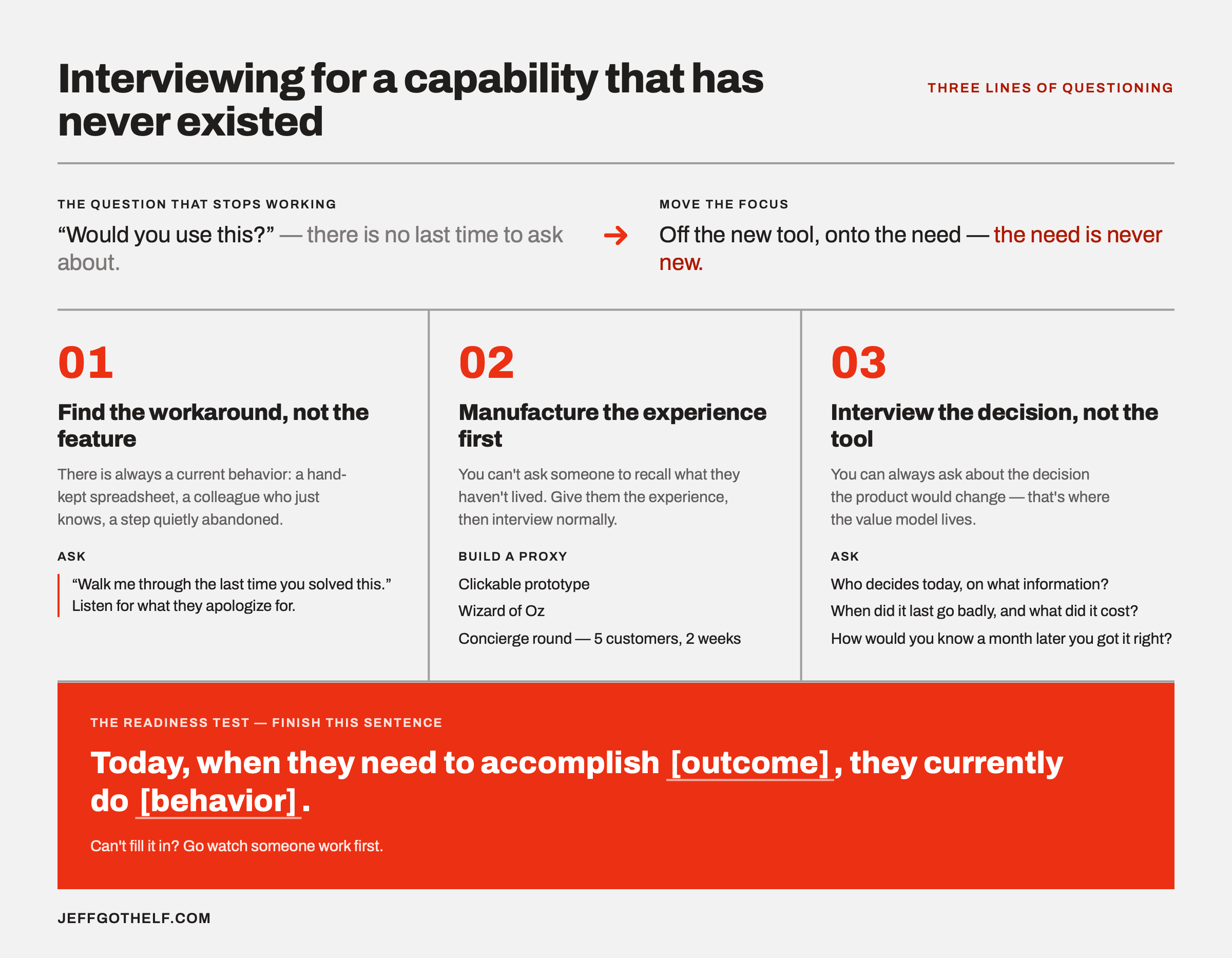
Nearly every customer interview technique rests on the idea that the person across from you has already done the thing you are asking about. In fact, the magic question we suggest to teams all the time is, “Tell me about the last time you had to do [x]?” The technique works because past behavior is the most reliable evidence we have about future behavior, and because asking about something that actually happened keeps the conversation out of the swamp of hypotheticals where people are unfailingly polite and completely wrong.
Then someone hands you an AI capability that has never existed before, in your product or anyone else’s, and asks you to go find out whether customers want it and can figure out how to use it. There is no last time to ask about and nothing to walk through, so the interview techniques we’ve relied on throughout our careers have to evolve. The most common fallback most teams reach for is the one we all know is broken. It’s describing the idea and then asking whether people would use it.
So what do we actually do? How do we run a customer interview about something the customer has never seen?
Why customer interviews break down for a capability that doesn’t exist yet
People don’t lack imagination. But they are bad at predicting their own future behavior in a situation they have never been in. People will tell you they would use it, that they would pay for it, that it sounds useful. They’re not necessarily lying. They are answering a question about a hypothetical version of themselves, and that person is more organized, more motivated and considerably more patient than the one who will actually open your product on a Tuesday morning (also they don’t want to be mean to you).
The answer is to change focus away from the shiny new AI tool on to the user’s needs. These needs are almost never new. They’re being met to some extent by some other means. That’s where all the useful information lives.
Three ways to run customer interviews for a new capability
1. Figure out the current workaround, not the feature. Before you describe anything you are thinking of building to your customer, find out how the person handles that job right now. There is always a current behavior. It could be a spreadsheet somebody maintains by hand, a colleague they message because that colleague just knows, a vendor they pay for something adjacent, or a step they have quietly stopped doing because it was not worth the effort. Ask them to walk you through the last time they solved for this specific need, in detail, and pay particular attention to the parts they apologize for. Those “apologetic” parts are the workaround. The workaround tells you the real job, what it currently costs the user in time and other currency, and how much tolerance they have for the current pain to get through the process. This is the same conclusion I wrote about in what “done” means when you’re shipping AI features, where the useful signal was always in what people did rather than what they said.
2. Manufacture the experience, then interview about it. You cannot ask someone to recall an experience they have not had. Instead, give them one. Once they have this new experience in mind, the interviewing skills you already have become useful and available again. You can create these experiences through simple prototyping and experimentation techniques including a clickable prototype, a wizard-of-oz version where a human does the work behind a convincing interface, or a concierge round where you do it manually for five customers for two weeks. The reason to be more aggressive about this now than we were three years ago is that the cost of building the proxy has collapsed. A working version of a novel capability is frequently an afternoon of work, which means the old objection, that we cannot afford to build something just to learn from it, doesn’t really hold water anymore.
3. Understand the decision-making process, not the tool. When you cannot ask about a product, you can nearly always ask about the decision the product would change. Who decides this today? Based on what information? When was the last time that decision went badly? What did it cost when it did? How would they know, a month later, whether they got it right? This line of questioning gets you to the value model and the success criteria without ever asking anyone to evaluate a feature, and it produces the thing you need on the other side anyway, which is a clear statement of who does what differently, and by how much, if this works.
Customer interviews still make sense, even for brand new AI products
Before your next round of interviews on a brand new user experience, try to complete this sentence about the person you are about to talk to: today, when they need to accomplish [outcome], they currently do [behavior]. If you can fill that in, you have the basis of an interview, and the whole conversation can be about that behavior and what it costs them. If you can’t fill it in yet, you may not be ready for the full-scale interview yet. Instead, go watch someone work, then ask them about what you’ve observed. With that in hand, you can start to get them thinking about your new AI-driven product experience.
Give this a shot with your next round of discovery and let me know how it goes.




2 responses to “How to Run Customer Interviews for a Capability Your Users Have Never Experienced”
This matches what we ran into. The workaround that helped us was to stop asking about the new capability at all and instead ask about the last time they did the job the capability would replace, in full, including the parts they hate. You get real behaviour, real workarounds, and a baseline you can measure the new thing against. The failure mode is the interview where you describe the AI feature first, because then everything after it is a reaction to your pitch rather than a description of their work. Asking about the job first and only demoing at the very end, if at all, made our sessions far more useful.
The move from “tell me about the last time” to interrogating the workaround is the practical takeaway here, and it is the one teams skip because asking about a hypothetical feels faster. What has worked for us is putting something in front of people that is deliberately unfinished — not a prototype they can click, just a short clip showing the capability behaving as if it existed — then watching where they interrupt. We assemble those with a faceless video workflow so a research round costs a morning instead of a sprint. Cheap enough that being wrong is fine, which is the whole point.