Late last year Jared Spool pointed out that no one actually wants to be on the receiving end of an AI-powered user experience. Teachers don’t want students using it to do their work. Customers don’t want to deal with customer service chatbots. Hiring managers don’t want AI to create resumes and job seekers don’t want AI to scan them. Given the runaway freight train levels of momentum for AI adoption and usage inside our companies, it doesn’t seem like the quantity of AI powered products and services is going to diminish. As the people tasked with building and shipping these products, let’s resolve to make them valuable and useful in 2026. Here are two questions to think about as you head back to work.
Will AI make this experience better?
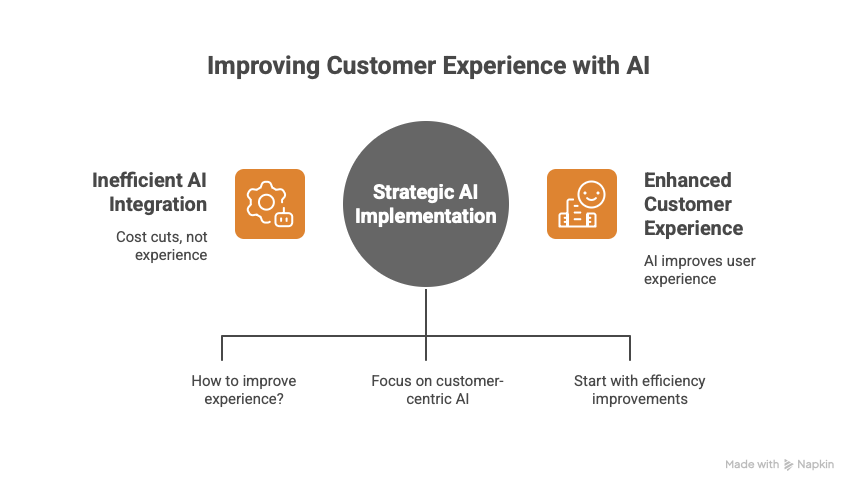
I know your boss wants AI integrated into everything. The real question for product managers and designers now is, “Will adding AI to this customer experience make it better?” Most of the ROI targets we saw from our clients in 2025 when it came to AI work weren’t revenue-based. They were based on projected cost cuts. The current state of the technology coupled with large companies slow adoption curves and legacy systems means that the primary goal for most orgs has been efficiency. This is a perfectly fine place to start. And while the short-term cost projections might be tempting, the questions to ask of ourselves and our leadership teams is, how do we make this experience better than it currently is if we add AI to it?
Given most customers’ experience with customer service chatbots, for example, fails far more often than it succeeds – sometimes as often as 86% percent of the time – human intervention is inevitable. This is the same human intervention the chatbot was designed, in theory, to cut out. So now, a company has not only invested in the chatbot and its ongoing maintenance and optimization, but is still paying for the same human-based customer service it was trying to cut out. And, in the process, it’s made the customer experience longer and more frustrating.
As you dive back into your 2026 project work, how might AI make the user experience better? This question is key to successful AI deployment. The realities of the tech and your org’s culture will play huge roles in answering these questions.
Where can AI be uniquely useful?
You might argue with me that this is the same question as above but I disagree. The first question takes a critical look at existing experiences and assesses whether you should try to force AI into them. This second question takes a critical look at the technology available to you right now and the potential opportunities in your customer experience where that AI tech might make it better. Instead of forcing AI into customer journeys that are better served by existing tech and humans, where might the nondeterministic nature of AI prove valuable to your users?
For example, let’s say you work in ecommerce and it’s coming up on the holiday party season. You see many site visitors looking through a variety of outfits and combinations to find something that makes sense for them. Perhaps this is an opportunity to use AI based on that customer’s shopping habits, their current search patterns and the time of year to put forward suggested outfit combinations they wouldn’t have found on their own. In this way you save them time, ensure their purchase and delight them with a convenient shopping experience.
AI or no AI, customers make us successful
Over the past 30 years or so we saw the internet revolution, then mobile and now AI. In all cases companies rushed to build a lot of trash that we love to ridicule now. AI is on that same path. We have an opportunity though, now, with the current state of our technology. We can research, synthesize and understand our customers and their needs much more efficiently. Let’s use that capability in 2026 to make sure we are making existing customer experiences better with AI and looking for the opportunities in our products where we might use AI to make an actual difference for the better. I’m rooting for you as are all of your customers.