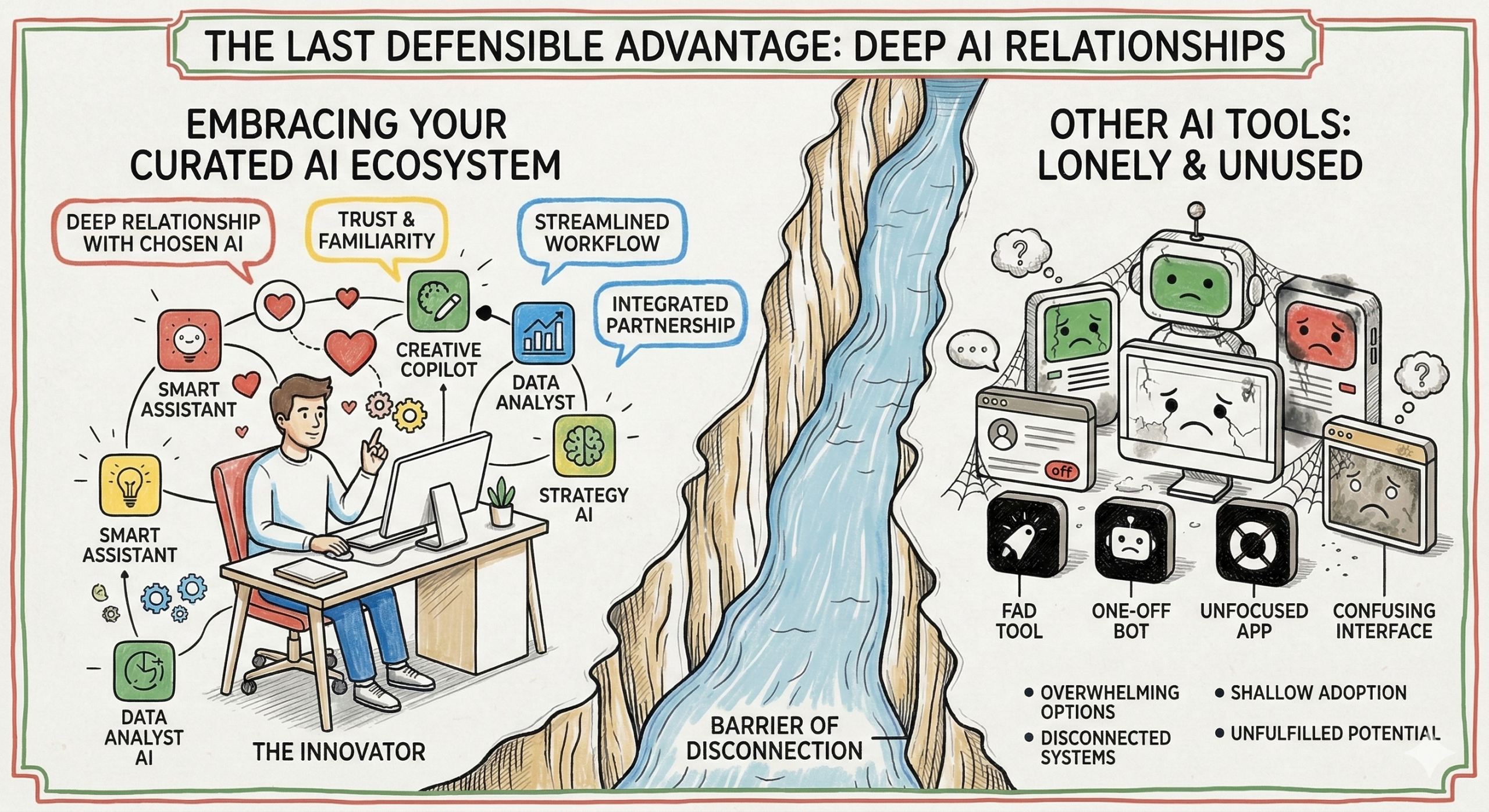
A friend of mine has gone all in on AI. He uses it to run his business, manage his personal life, and control his house. Nearly every aspect of his daily routine flows through a set of agents he manages centrally with text and voice commands — generating whatever result he needs from wherever he happens to be. When I asked which AI products he was using, he easily listed off the various products he’d put in use. ChatGPT, Claude, OpenClaw — he went down the list until, at the end, he added, “..but it doesn’t really matter.”
And the thing is, he was right. The features across any of these AI systems are roughly identical. What isn’t identical is the relationship he’s built with the tools he chose. The history. The context. The deeply embedded integration into the way he works and lives. That is a moat. He is not switching providers at the drop of a hat because there’s too much invested to walk away from.
That moment stuck with me. Because it’s the clearest example I’ve seen of what I believe is the last defensible competitive advantage in an AI-enabled market.
Features are commodities now
Over the course of the past few weeks, I’ve argued that AI has made execution cheap — cheap enough to change what good work looks like, cheap enough that provisional decisions beat perfect ones. The natural conclusion of that argument is this: if anyone can build anything faster than ever before, features aren’t a moat anymore. Your competitor can ship what you shipped last quarter by next week. The enterprise playbook — protect market position through superior functionality — is obsolete. Not struggling. Obsolete.
What remains is the relationship. My friend doesn’t know the technical specs of the AI products he uses. He doesn’t care. What he does know is that those systems know him — his preferences, his routines, his context, his language. That accumulated understanding of who he is and what he needs is what makes switching expensive. Not in dollars. In friction, lost history, and diminished output. That’s the new moat. And building it requires a different kind of investment.
The fundamentals of good product management were never more essential
Here’s what I find genuinely exciting about this moment: the tools to build a relationship-driven advantage have existed for years. We just never had this much pressure to actually use them.
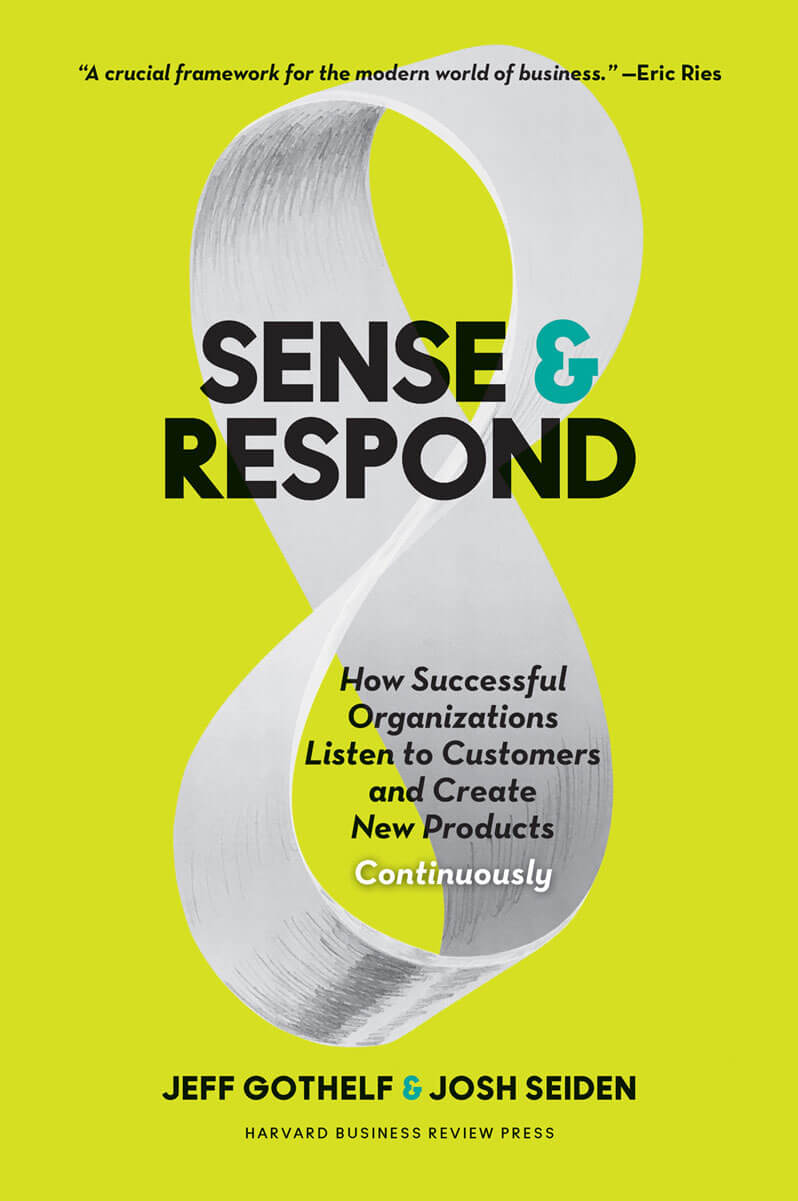
Customer-centric OKRs force teams to define success in terms of customer behavior change, not features shipped. They make “the customer is demonstrably getting value” the measurable outcome rather than an afterthought. Product discovery — through Lean UX, continuous user research, and real conversations with real people — builds the sensing capability that makes it possible to understand what customers actually need before they have to ask. And Sense & Respond, the practice of treating every release as a hypothesis and every user signal as feedback worth acting on, is how you stay close as needs evolve.
These aren’t new ideas. They are the fundamentals of good product management. The difference today is that companies that skip them aren’t just leaving value on the table — they’re leaving the moat unbuilt.
The feature race ends in a tie. It ends in a tie faster than it ever has. The companies that win from here are the ones whose customers have built enough history, enough context, enough trust that switching feels like starting over. That doesn’t happen by accident. It happens because teams invested in understanding their customers, measured the right outcomes, and continuously improved the relationship through every interaction.
That’s what the AI era demands. Not better features. Better relationships.
Start building those relationships now.




Leave a Reply