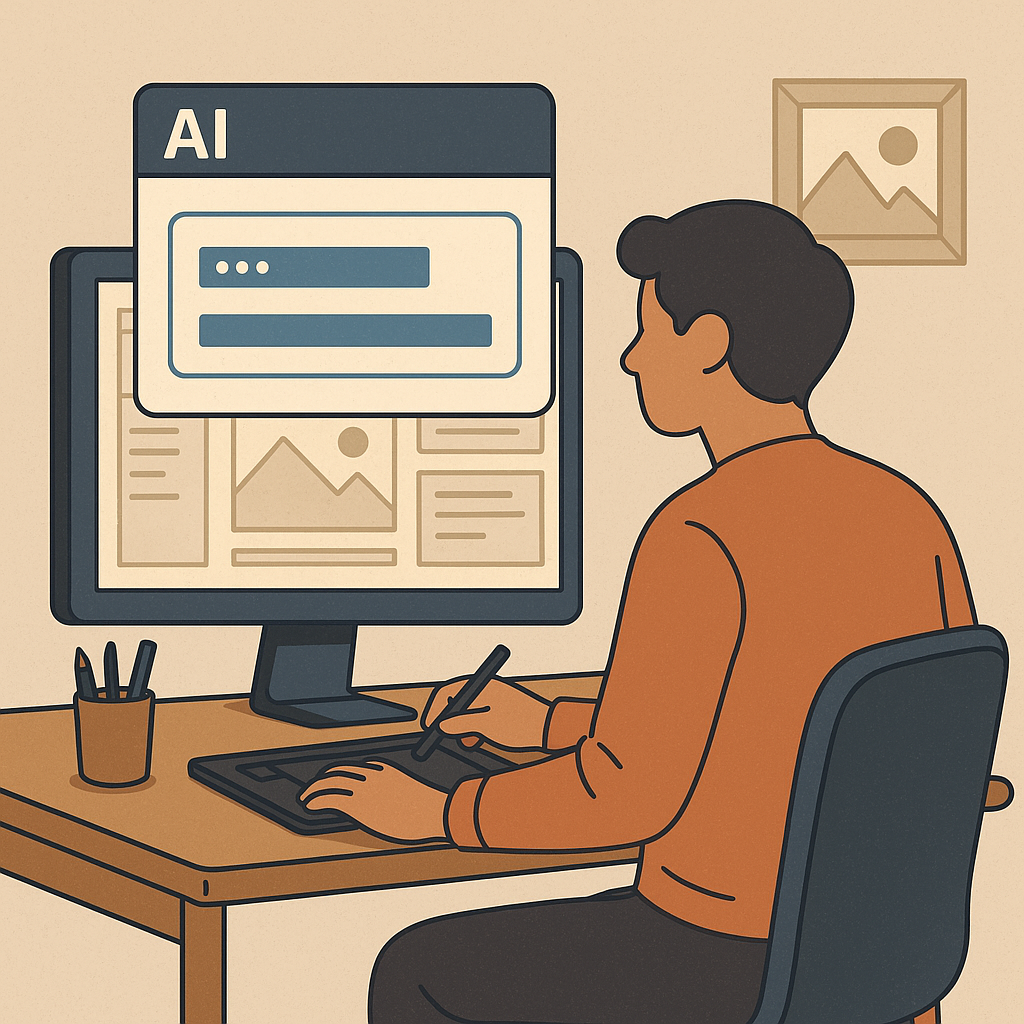
I’ve been working professionally in the tech field for 26 years. After a bit of a late start compared to my university cohort (rock bands, circuses and a couple of other wayward explorations delayed me) I gravitated towards web design. That transitioned quickly into information architecture followed by user interface design and eventually user experience design (UX). While I’ve moved on from doing UX work these days I’ve been thinking about “the old days” of UX a lot after attending my daughter’s graduation from university with, perhaps not surprisingly, a degree in user experience design. In many ways she’ll be doing work very similar to the work I was doing when I started. In many other ways, UX is a whole new ball game. The culprit? As it seems to be everywhere else these days, it’s AI.
What’s not changing in UX due to AI
I’m not a luddite nor an AI denier. However, many challenges that we faced building Web 1.0, 2.0 and mobile products and services remain the same in the age of AI. Most of all we have to remember that the products and services we build serve other humans. Many of those humans have now grown up with a mobile phone, laptop and screen-based interaction models as the default. That doesn’t mean that they instinctively will know how to interact with our newly empowered AI-driven tools.
So many companies are just “implementing AI” as a perceived way to stay competitive. Much of the time this is rushed, not planned with the customer in mind and designed to be able to put an AI badge on their marketing copy. What we end up with is AI buttons everywhere with no rationale or meaningful workflow for their usage. They don’t make the user more successful. They make the user experience worse.
These are classic UX design problems and they’re not going away. These are the same issues albeit with different technological shiny objects that we were dealing with as freshmen designers in the late 90’s and early 2000’s as well.
What is definitely changing in UX due to AI
With all that being said, there is massive change happening on a nearly daily basis in the world of user experience design due to the proliferation of AI. From my external perspective, the fundamental change I’m seeing is in the doing of the design work. The tools we used when I started my career – Visio, Omnigraffle, Photoshop, Illustrator, Dreamweaver (nod along if these make you nostalgic) – seem like caveman tools compared to the AI-powered automation my daughter and her classmates have at their disposal.
Where this nets out is in productivity. Tools like Lovable and Bolt, generate clickable usable prototypes in minutes versus the hours if not days of work it used to take. AI improvements in collaboration and layout services like Mural and Miro reduce the time it takes to get from a blank page to something useful to seconds. Customer intelligence tools like Dovetail, make capturing, summarizing and synthesizing user feedback quick and easy. Even the powerhouses of the past decade or two (or four) like Figma and Adobe have put AI features to use in ways that drive designer and team productivity to levels we never imagined when we were building the first set of dot com websites (after we just nearly avoided the Y2K disaster 😉 .
Where it once took days if not weeks to get to a clickable, usable prototype a team could gather around and debate not to mention show to users, it now takes hours at most. The number of people it once took to get to a customer-facing deliverable (not necessarily a final product) is also dramatically lower. Teams are leaner. Work is faster. Feedback flows in at incredible rates. It’s actually hilarious for me to think that when I worked at AOL we’d have to wait 6-12 months to get real user feedback on our work. Today, it can happen in 6-12 hours. Incredible.
Impact, risk and caution
I hate to do it. It’s cliche. But I’m going to do it. “With great power, comes great responsibility.” I’m sorry. But it’s true.
Just because you can build something faster doesn’t mean it’s better. Also, allowing the AI to understand your customers instead of you taking the time to understand them risks outsourcing the critical thinking to an LLM built with inherent prejudice and a lack of contextual understanding. Generating wireframes, designs and prototypes in minutes risks not truly understanding what makes a user successful with one interface over another. And, perhaps most importantly, it reduces the humans in the creative process to prompt engineers ensuring that every new digital product service devolves into a homogenized “best practice” distillation (remember when Twitter’s Bootstrap came out?).
My advice to designers today, including my daughter, is this. Yes, use AI powered tools. Be more productive. Build better systems faster. But take the time to understand the context, the humans you serve and the results served up to you by the bots. Question them. Challenge them. Rewrite them and, in many cases, retrain them to give you the results you need and your customers need, not the diluted ones the algorithms provide.
The winning products of the AI age will be the ones that stand out in the world and what makes products stand out is what always has. It’s solving real problems for real users in ways that provide real value for their unique contexts. With AI-powered tools we can deliver even better contextualized solutions faster but only if we take the time to understand the people we serve and the problems we’re solving.
I’m rooting for all of you.




One response to “The Impact of AI on UX Design Work”
Awesome! Its genuinely remarkable post, I have got much clear idea regarding from this post