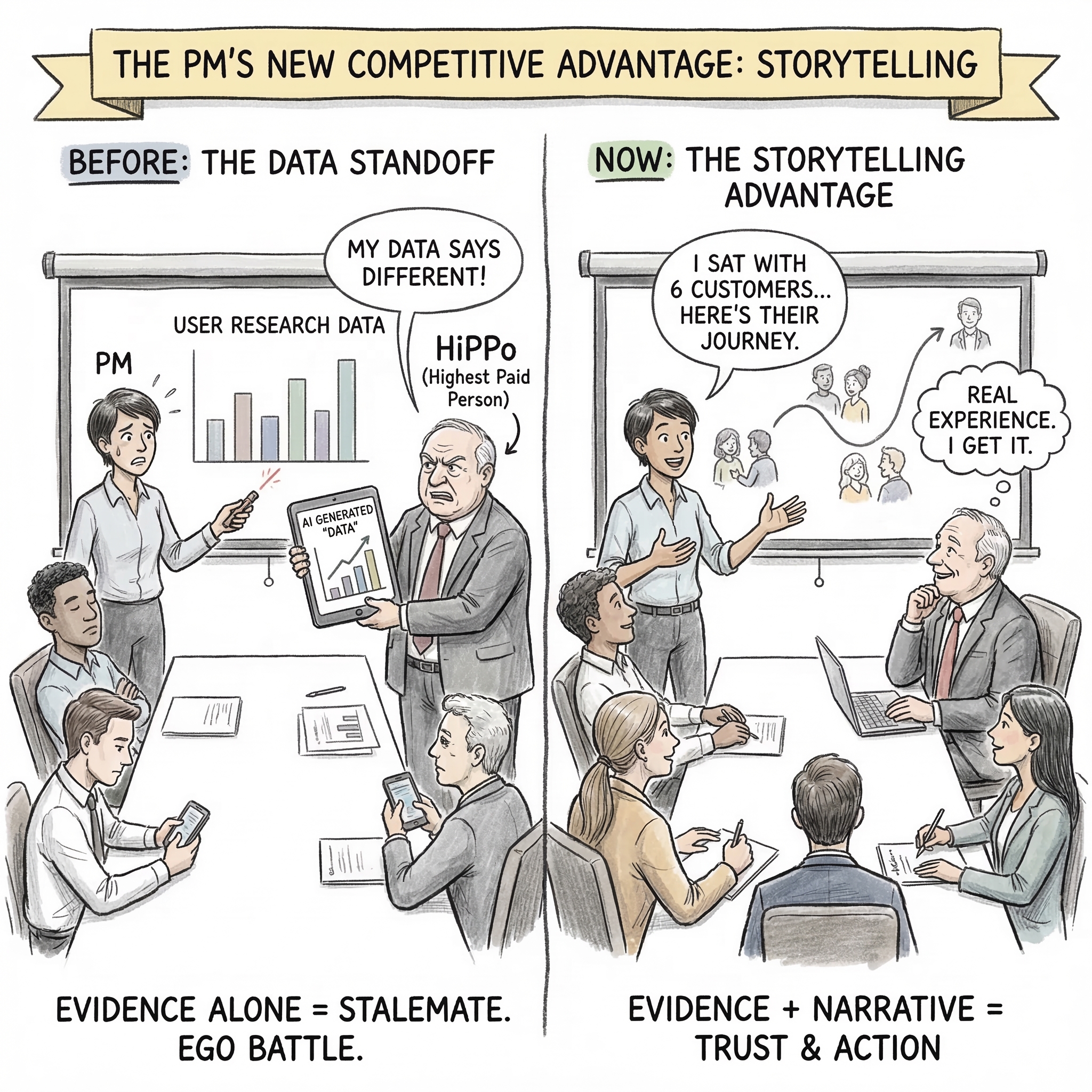
I know you’ve been in this meeting.
A product manager presents their recommendation. Weeks of customer research behind it. Real data. Real observations. The kind of evidence that should settle the question with minimal debate. A senior stakeholder pushes back. “I have data that says something different.” The room goes quiet. Now it’s a standoff — two claims, two datasets, nobody moving. Whoever has the louder voice or the higher title – aka the HiPPo (highest paid person) – usually wins.
That’s not a product decision. That’s an ego battle.
Now add AI-powered work to that scenario. It’s not unlikely that the stakeholder’s “data” may have taken them twenty minutes to generate. A quick prompt, a synthesized summary, a chart that looks like research. It didn’t come from customer interviews or deliberate product discovery — it came from a tool that’s available to everyone. So did the spec on their next slide, and the competitive analysis in the appendix.
This is the new reality of product work. The outputs that used to signal PM expertise — the research synthesis, the user insight, the prioritization framework — are now table stakes that anyone in the room can produce. The question is no longer who can do the work. It’s who can make the room feel that the work came from real experience, real expertise, and real evidence.
That’s storytelling. And it’s becoming the PM’s most important competitive advantage.
Evidence Still Matters — More Than Ever
Let me be clear: this is not an argument for skipping the research. Do the customer interviews. Observe real behavior. Build the evidence base. None of that changes. AI actually makes this part easier — you can synthesize faster, find patterns quicker, and go deeper in the same amount of time. A PM doing the actual discovery work with AI support now has more raw material than any PM could have assembled even 2 years ago. Take full advantage of that.
The difference is that evidence alone no longer wins rooms. Your stakeholder also has evidence. Their manager has evidence. Everyone walked in with a chart.
What separates the PM who moves the room from the PM who loses the debate isn’t the quality of their data. It’s the story they’ve built around it — one that makes clear this insight came from a human who spent time with real customers, made real judgments, and did real thinking. AI can generate a research summary. It can’t replicate what happens when a PM says, “I sat with six customers last month and three of them said the exact same thing without being asked. Here’s what that means for this decision.” That specificity coupled with an expertise that can only come from physical, human presence is the signal to the room that earns trust.
Know the Room You’re Actually In
Speaking of rooms, here’s where most PMs leave the most on the table. They tell the same story to every audience. The customer insight that lands in a design critique gets blank stares in a CFO review. The UX finding that moves an engineering team doesn’t move a VP of Sales. Same evidence but presented with the wrong story to the wrong audience.
Compelling storytelling in product management is about translation. You have to connect the insight to what the specific people in that room care about most. In a review with your design team, lead with the user’s journey — the friction, the confusion, the unmet need you watched someone struggle with. In a roadmap meeting with business leaders, that same insight needs a different frame: what’s the revenue risk if we ignore this? What’s the retention impact? What does this mean for the targets we committed to this quarter?
The customer’s reality and the business’s goals are not competing storylines. The best PMs connect them in a single narrative that makes both feel urgent. That connection is the story. It requires you to understand your audience before you walk in the door — and to adapt deliberately, not accidentally.
Why This Is Now a Competitive Advantage
Let’s be honest about where we are. AI has made it possible for anyone to produce PM-looking work. Specs, summaries, personas, prioritization matrices, competitive landscapes — a reasonably curious person with a good prompt can generate a version of all of it, quickly. That’s not a threat to product management. It’s a clarification of what product management actually is.
The work was never about the artifact. It was always the judgment behind the artifact. The understanding of the customer. The connection to the business needs. The ability to walk into a room of skeptical stakeholders and make them feel, not just intellectually accept, that this is the right direction.
You’ll use AI in your work. That’s a given — and you should. But the PMs who stand out in the next few years won’t be the ones who prompt the best. They’ll be the ones who can take everything they’ve learned — from customers, from data, from experience — and turn it into a story that earns a room’s trust and moves people to act.
That requires deliberate practice. Pay attention to how you present. Notice when you lose a room and diagnose where the story broke. Practice translating the same insight for different audiences. Treat communication as a craft, not a soft skill, and invest in it accordingly.
The best argument doesn’t always win. The best story usually does.
Want more? We teach Storytelling for Persuasive Conversations at Sense & Respond Learning.
Sign up for a FREE webinar on this topic coming up April 5, 2026 here.




Leave a Reply