I visited a client last week. They’re a midsized company working in a mix of B2B and B2C environments. They’re facing the same level of AI disruption as everyone else. They build products very much like everyone else with roles that you’d all find familiar. Despite the incredible pace of innovation and change right now in digital products and services, do you know what challenge they struggled with the most? Collaboration. Role definition. Customer-centricity. Yep, in 2025, hip-deep in the AI tsunami, the fundamentals of product development are still the most important determinant of your success.
This isn’t a rejection of current reality
Every headline and case study boasts how AI is driving efficiency inside organizations. Yet, many companies we meet and speak with are actually abandoning revenue-based ROI metrics for AI initiatives, opting instead for cost-cutting metrics (read: layoffs). There is absolutely an efficiency to be gained with these new tools. Not only productivity but capability for each individual contributor should increase in the coming months and years. That productivity and broadening skillset, however, is useless if the amplified output now being created per person isn’t going toward solving real customer problems. In addition, it risks a significant duplication of effort if the collaboration between our now AI-enhanced colleagues is breaking down.
The fundamentals keep the train on the tracks
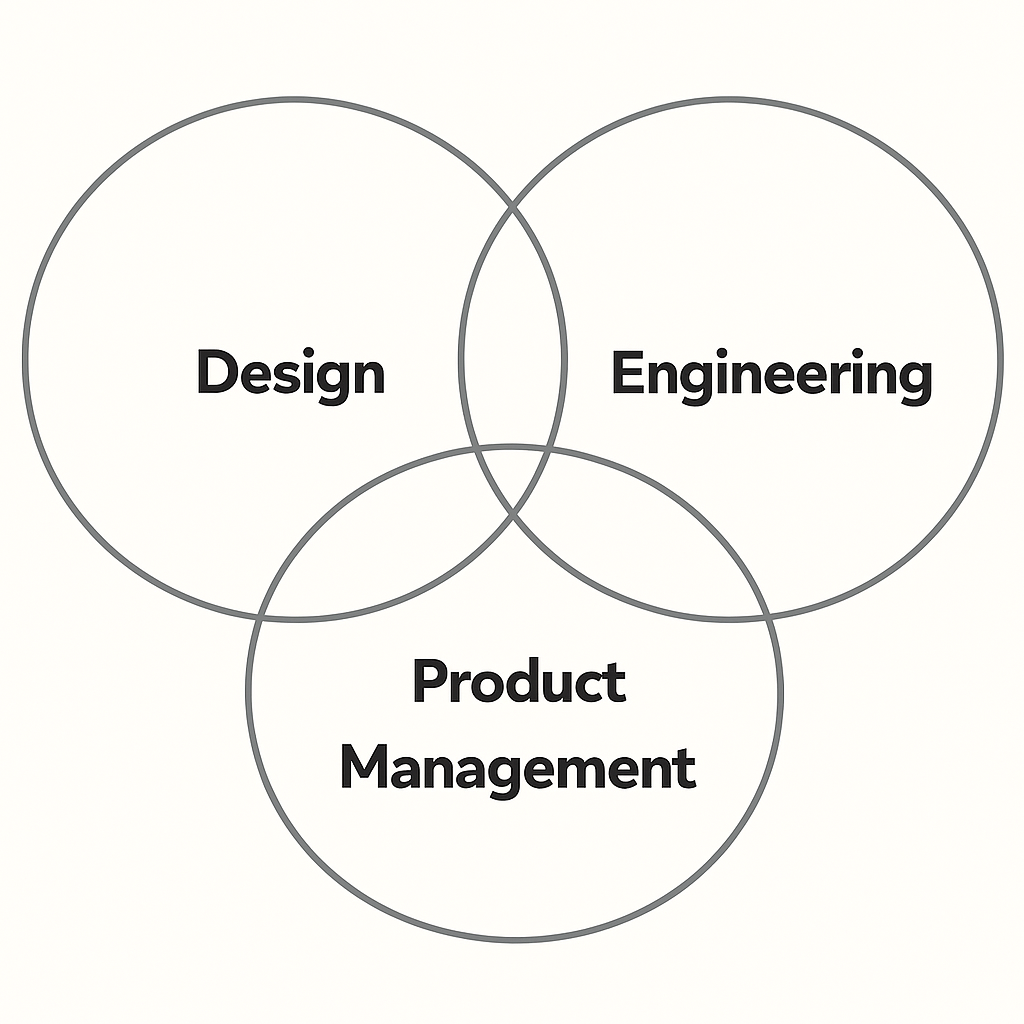
Having clear conversations about roles, responsibilities and boundaries makes even more sense now that skillsets are seemingly more evenly distributed. This won’t slow down any time soon. In fact it will continue to challenge our current roles and how they contribute to the development of the products and services we create. At the same time, it’s the organizations that have the tough conversations, like my client last week, about how that’s shifting and what that means for designers, product managers and engineers that are going to be able to take the fullest advantage of the AI revolution.
What does prototyping look like now? What about knowledge management? Customer development? Team and client facilitation? Customer support? And, perhaps most importantly, how do these activities inform each other in a way that adds usable insight to each team and team member rather than overwhelming them.
As always, cross-functional teams do better here. They talk more. They share more information and they make decisions in less time. Understanding that roles will evolve is key and ensuring our teams are actively having those conversations is critical to their success. At some point, some lines will have to be drawn. “This is how we work now.” Great. Draw that line and let the new ideas run for a while. If they deliver happier, faster, more productive customer-centric teams, terrific. But, if they don’t, synthesize that data and adjust the “way we work now.”
The temptation to radically reinvent is strong
The pressure to rethink how we work is intense. Seemingly every leader is asking for it. If you’re in a small startup reinventing how you work with AI as the backbone is possible. It won’t be easy or simple but shifting a few dozen people’s behavior isn’t impossible. In larger organizations, as with any change, ROI will come more slowly. Use that to your advantage to learn. Lean on the fundamental team structures that have worked for the past years. Those cross-functional collaborations will help you figure out where to go next. Resist the urge to blow it all up. The chaos and the path back from it is undoubtedly more costly than the ship, sense and respond process you can follow now to evolve to your new operating processes.