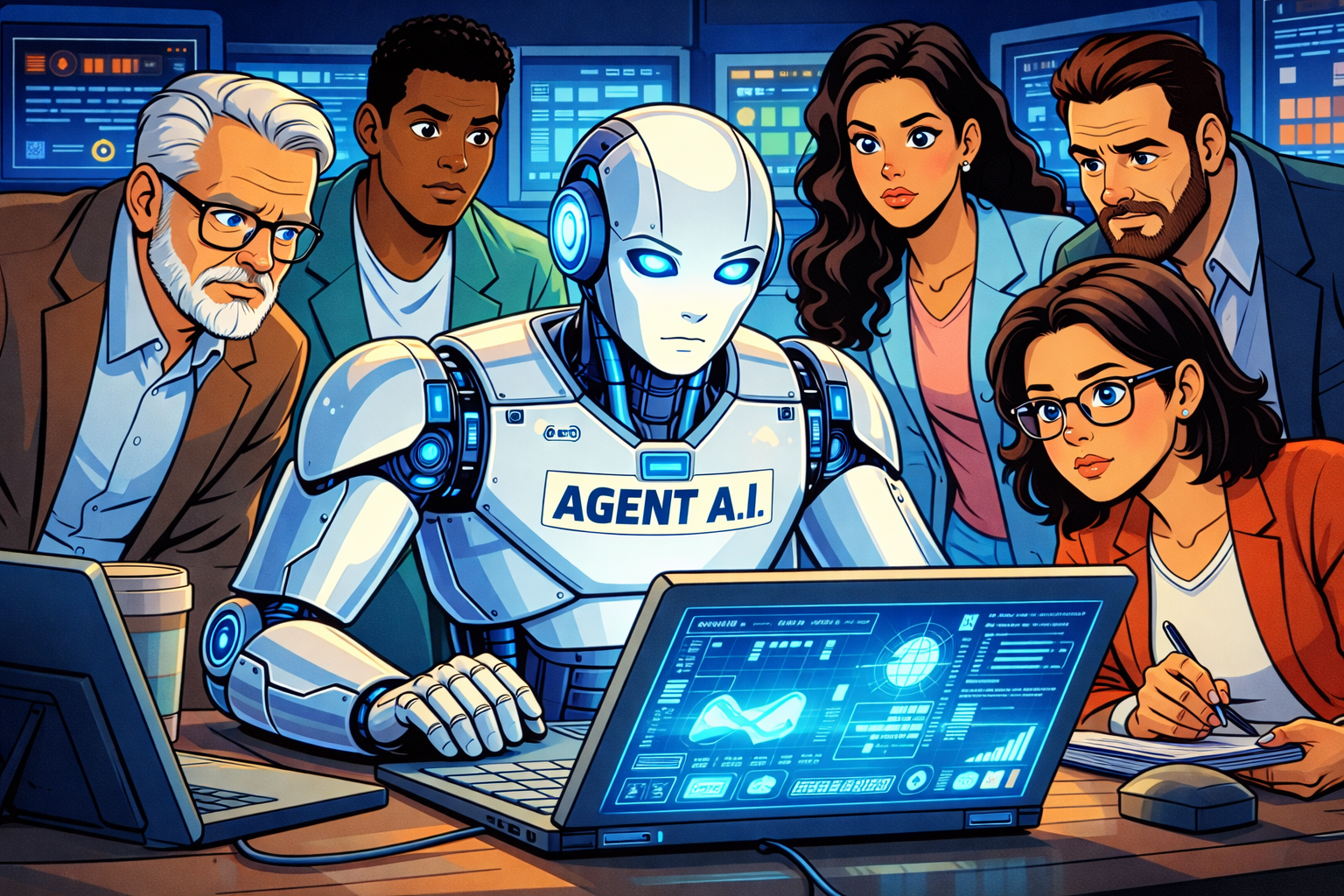
I just watched this fascinating video about Claude Co-work. It was impressive. We’re taking small steps forward, quickly, towards meaningful value in knowledge work with AI tools. Agentic AI seems to be that next paradigm shift. At Sense & Respond Learning we’ve been working to figure out how we can use agentic AI to improve the way we work with our customers regardless of where they are in their customer journey. Regardless of the interaction models and the benefits they promise, we’re still not abandoning the requirement for a watchful and critical human eye. We’re bullish on the new technology and, while we’d like to blindly set it loose, we continue to have a trust but verify approach to any new rollout.
Agents everywhere
If you go to our website you’ll find the little meatball down in the bottom right corner that triggers the AI bot. Its goal is to help you find what you need quickly and then pass you off to a human. We’ve worked through dozens of scenarios and their related prompts to make sure that when you ask it a question it gives a current and relevant answer. And, most importantly, if it doesn’t know, it hands you off to a person right away. With easy questions it does well but when our analytics and reporting come back showing how it was failing to help certain sight visitors we went back in to tweak the prompt again (and again).
With a big focus on outbound business development this year we started dipping our toe into the world of agentic AI SDRs. SDRs are sales development reps. Traditionally, these are junior sales folks whose job is to do cold call outreach to prospects with the goal of getting them on a more senior sales person’s calendar for a call. We don’t have any junior sales people so we’re started taking product demos from Agentic AI SDRs. At first glance these bots are pretty incredible. With a relatively small amount of effort the bot is up, running and contacting prospects with personalized messages without needing to take a break, ever. It’s impressive, to say the least. However, this bot is making first contact for our brand with hundreds and potentially thousands of people who have never heard of us. I’d love to blindly trust it to do a brilliant job but I still have to verify. Response rates, replies to communications and a random sampling review of the emails it wrote are required behavior on our part to make sure every contact with the SRL team – bot or not – is professional and up to our brand standards.
Trust but verify – the path to deeper AI integration
AI is here to stay. We need to find the use cases where it makes the most sense for us to integrate it into our ways of working. Cutting humans out of the loop, at least for now, is not an option. We need a clear sense of what “good” looks like and continue to ensure that the bots we deploy are actually putting that goodness out into the world. In other words, regardless of how shiny or impressive a new iteration of the AI tools we use may look, it’s ok to trust but verify.