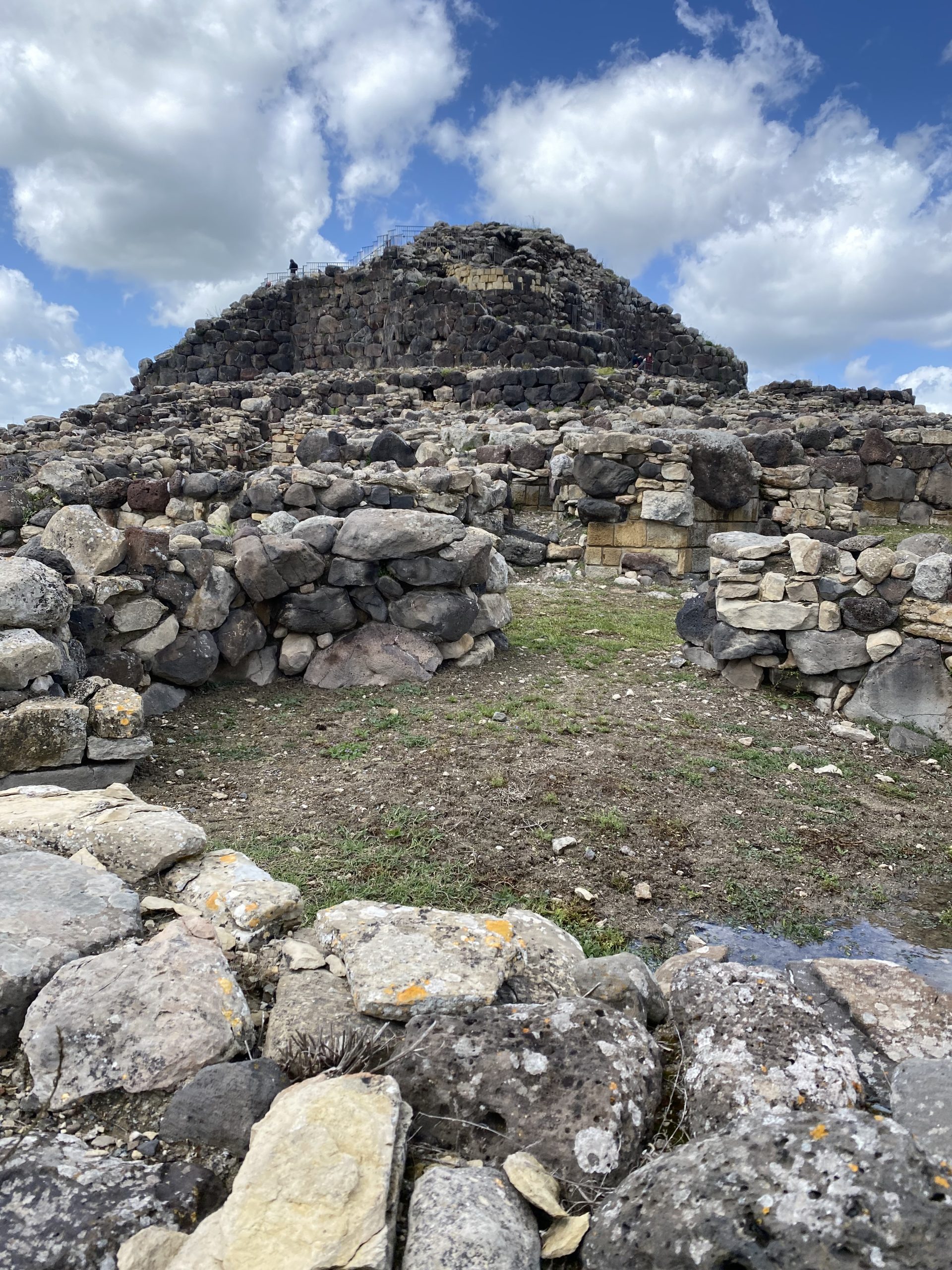
I just got back from a short holiday in Sardinia. In case you’re not familiar, it’s the second biggest island in the Mediterranean located to the west of Italy and just below Corsica. It is part of Italy (to many of the residents’ dismay). It’s a stunning and diverse island with a tremendous amount of history dating back 6000 years. One of the most fascinating historical aspects of Sardinia is the mark left by the Nuragic people who lived there from the middle of the Bronze Age until the middle of the Phoenician Age (about 1700 BC until 500 BC roughly. They left thousands of structures all over the island. We went to visit the largest and best preserved one called Sa Nuraxi and took a guided tour. We learned so much about what transpired there so many years ago. I suspect we could have learned more.
When your job really is all storytelling
The tour guide clearly knew the history of the site, the structures and the people who lived there. She shared those facts with us while pointing out specific areas of archaeological and historical interest. For example, when fully constructed it is hypothesized the structure at Sa Nuraxi resembled a medieval castle – nearly 3000 years before such structures ever existed on the European mainland.


In that way she was an excellent tour guide. However, there is so much more to the story at this remarkable site than just facts and figures. Here is where I would have appreciated better storytelling skills. The data is valuable. I want to know the approximate dates of construction, population numbers, weight of the stones and other interesting facts. I also want to know how they weave together the history of the people who lived there. The storytelling part of the tour was missing for me. Maybe I’m a bit hypersensitive to this these days. Maybe it was a language barrier issue (which in no way should minimize the flawless English in which the tour was presented). Facts and figures only tell so much of the story. When you’re trying to understand the culture of a people, the reasons behind the choices they made in their lives and the rise and fall of their civilization, you want to hear their story.
I wanted to know why.
Storytelling weaves the facts together
There’s a short video clip we use in our storytelling class from the creators of South Park where they share how they build each episode. Instead of using the word “then”, they use the words “so”, “therefore” and “but.” The difference is evident.
“The Nuragic people built this tower then they built this well then they built this third tower.” Instead, it could be, “The Nuragic people started building the first tower on this site therefore it became the center of the village so they expanded outward from there but they ran into trouble when they got to the river.”


There’s a big difference in those two accounts. One is a list of facts. The other is the beginning of an interesting story that weaves together the facts into a compelling narrative that captures the audience and engages them immediately.
Next time you’re up in front of an audience sharing your insights and expertise, ask yourself, “Am I listing a bunch of facts or am I telling a story?”