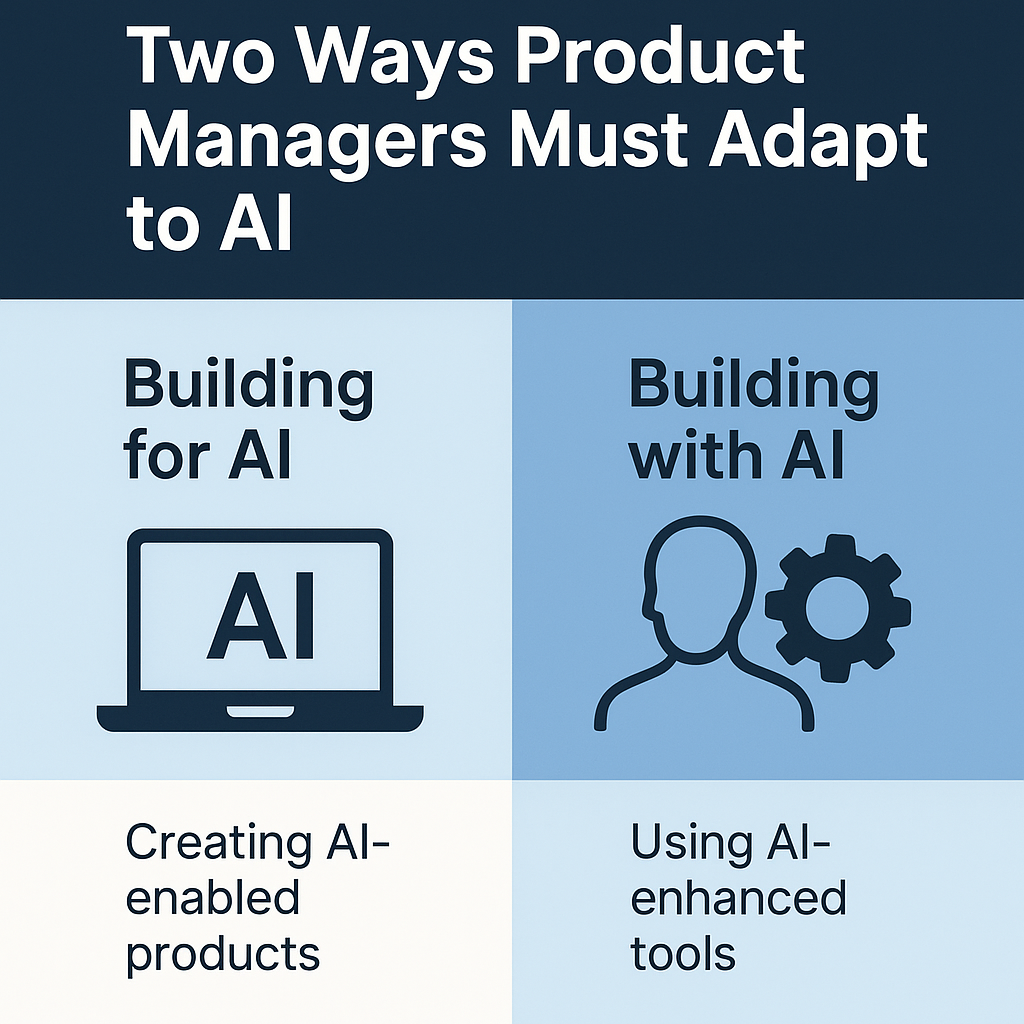
Product management is evolving at such a rapid pace given AI’s lightning pace of adoption, I thought I’d take this week’s blog post to talk about a way we’re looking at breaking down these changes into two manageable types of thinking and content. At a glance, the AI landscape is not only overwhelming but evolving on a near-daily basis. As product managers grapple with the change and try to figure out what they need to learn, I’d like to offer a way to divide and conquer that challenge.
Building for AI
When you’re building for AI, you’re building AI-enabled products. In this situation you need to understand what capabilities AI has and how to apply those capabilities to your product, service or business. In this scenario you’re looking for use cases and contexts where AI can enhance the user experience. You’re considering how to best integrate AI capabilities into that workflow and how to ensure that your customers know how to use it.
In addition you’ll need to get familiar with LLMs (obviously), agents, evals, and integrations into your unique contexts and user interfaces. In addition to understanding the technology you’ll need to adjust your product development process to take into consideration the non-deterministic qualities of AI-powered experiences. Since we won’t know what our users will input into our systems and we won’t know what the AI-enabled system will output back to those users we have to ensure that agency is only handed over to the system as it proves its accuracy over time. Building for AI is the evolution of the work of being a product manager.
Building with AI
When you’re building with AI you’re using AI-enhanced tools to do your job as a product manager. On this side of the equation your goal is to find a suite of tools that allow you to do the work of a modern product manager but with the efficiency that AI-powered tools can bring. For example, you’ll need to choose a tool that captures and summarizes notes across your customer interviews. Perhaps you’ll update your prototyping tool of choice. Vibe coding services can greatly improve the pace with which you can visualize a proposed experience to stakeholders and colleagues alike.
The goal here is to choose a suite of tools that make you more efficient, productive and accurate. Work that used to take days or weeks now takes minutes. You’ll need to keep up. Here, too, the options continue to change but there are some key players – both old and new – that are a good place to start. Figma as always is continuing to make useful, AI-powered tools for product managers and designers alike. Lovable is a great place to start vibe coding. For note taking and analysis I like Granola. Your mileage will definitely vary. The only way is to start trying the tools out and settling on the ones that fit your workflow best.
Stay current by breaking the learning in two
Rather than seeing the work needed to stay current as a product manager in the AI space as overwhelming, break it in half. Consider what you’ll need to know to build for AI products. What can the tech do? How can it best be used to make your customers more successful? Then, start experimenting with how to build with AI. Which tools might you try to make you more efficient? Productive? Try a few, settle in on a subset and get to work.
What are you doing to stay current as a product manager in a world obsessed with AI?